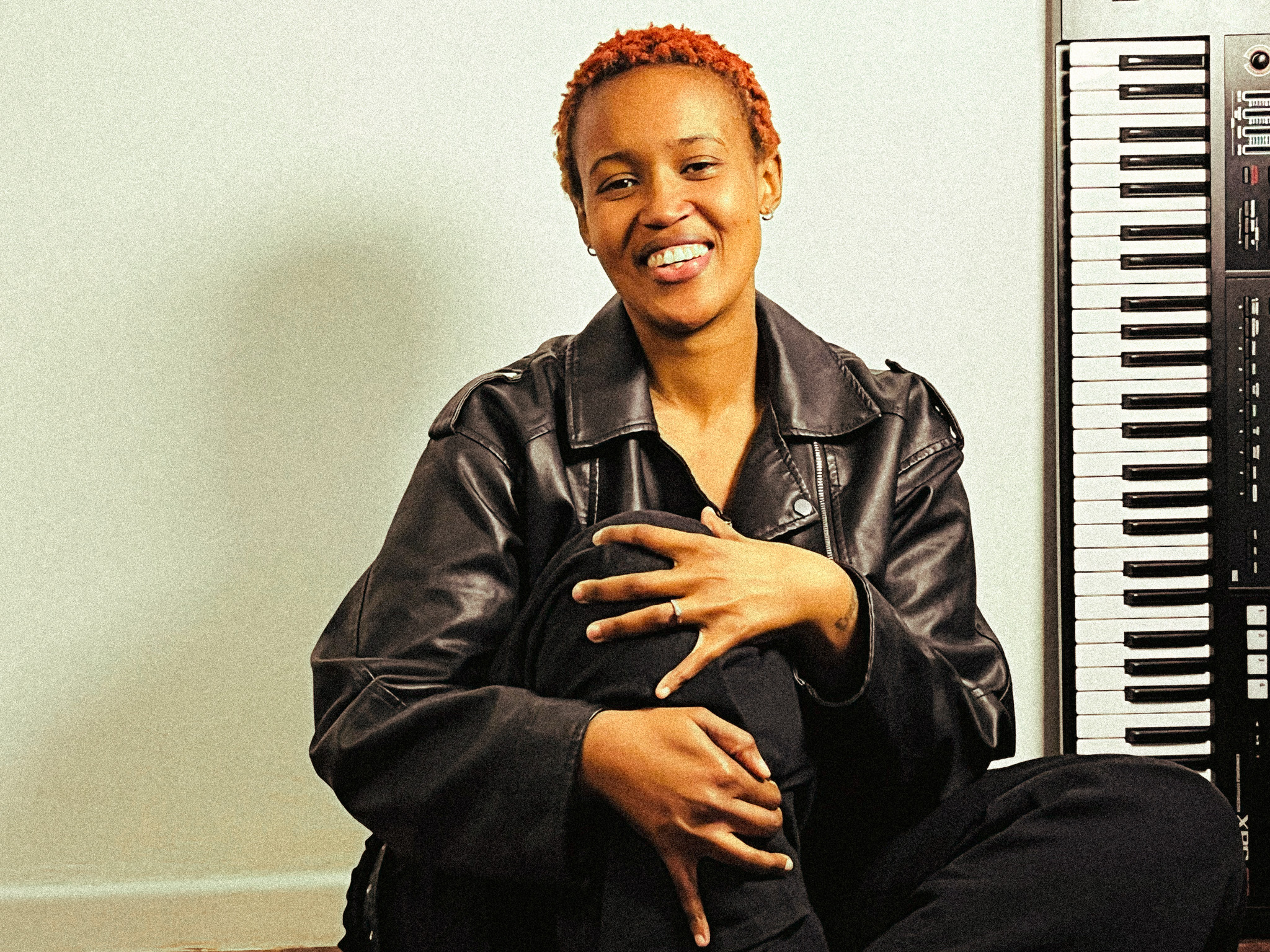
“I don’t aim to make music a certain way; I create from what has shaped me over the years, and the rest naturally falls into place.” – Thembelihle Dunjana
Written by Hlengiwe Mkwayi
When I met with Thembi Dunjana, I had no idea that I would get a crash course on isiDubaba: a playful language drawn from isiXhosa, that twists vowels and syllables in ways that make the ordinary sound musical. I learned that in this secret code, my own name would be Hledengidiwede. This exchange was a small glimpse to how she thinks about music: as a form of play in creation and a bridge between memory and imagination.
With a BMUS in Jazz Performance and a Master’s in Music from UCT, she has released two acclaimed albums: Intyatyambo (2020) and God Bless iKapa. God Bless Mzantsi. (2024). Through this conversation, we get into her music approach which borrows from the rhythms, sounds, and playful moments of her childhood, transformed into compositions that feel alive in the present.

I’d like to begin with a question as equally important as “where do you come from”: Who named you, and what does your name mean to you?
My dad named me; his name is Thembile and I am Thembelihle. I wouldn’t say the name itself means that much to me. What matters is that he gave it to me. My dad is a very important figure in my life. But a name is a name. It doesn’t quite define me. I’m not my name. I think names are practical, for sure. All I’m saying is that I don’t have a deep connection to mine.
While we’re on the subject of naming, let’s talk about your album and its title, God Bless iKapa, God Bless Mzansi. The title gives a sense of Cape jazz and church/spiritual influence. Then there’s your Xhosa heritage. How do all these threads, the spiritual, the cultural, the musical, work together in your playing songwriting?
The whole ‘Cape jazz’ thing is a weird term for me, because when I make music, I don’t think about trying to sound a particular way. When people say Cape jazz, they might think of ghoema music — and sure, growing up in the Western Cape, I heard that a lot, even from the teachers who taught me. But I also grew up in a Xhosa household, and that shaped me too.
I got into art because I love art. I don’t always go into my music with a specific meaning or message I want to push. Because of who I am and what I grew up around, those influences naturally show up in the music. I honestly don’t know how else to compose besides drawing from what formed me. So when this question comes up (and it always comes up) the truth is that I don’t write with the intention of making the music fit a certain category. I’m driven by the art itself, by how harmonies come together and how chord progressions move. Everything else, the cultural references, the stylistic labels — those happen on their own, and people name them afterwards. And I can agree with them, because it is part of me.
To go back to your earlier question: the titles usually come after the music is shaped. I name the work based on what feels right once the sound already exists.
But of course, I’m a person who was born and raised in Cape Town. I’m South African. Those things matter to me. And at that time, I had just had my first child. I’m a Christian as well. So all of those things came together. For a second album, it felt right for it to be a message of gratitude; bringing everything home and honouring where I come from, because I really do love where I come from
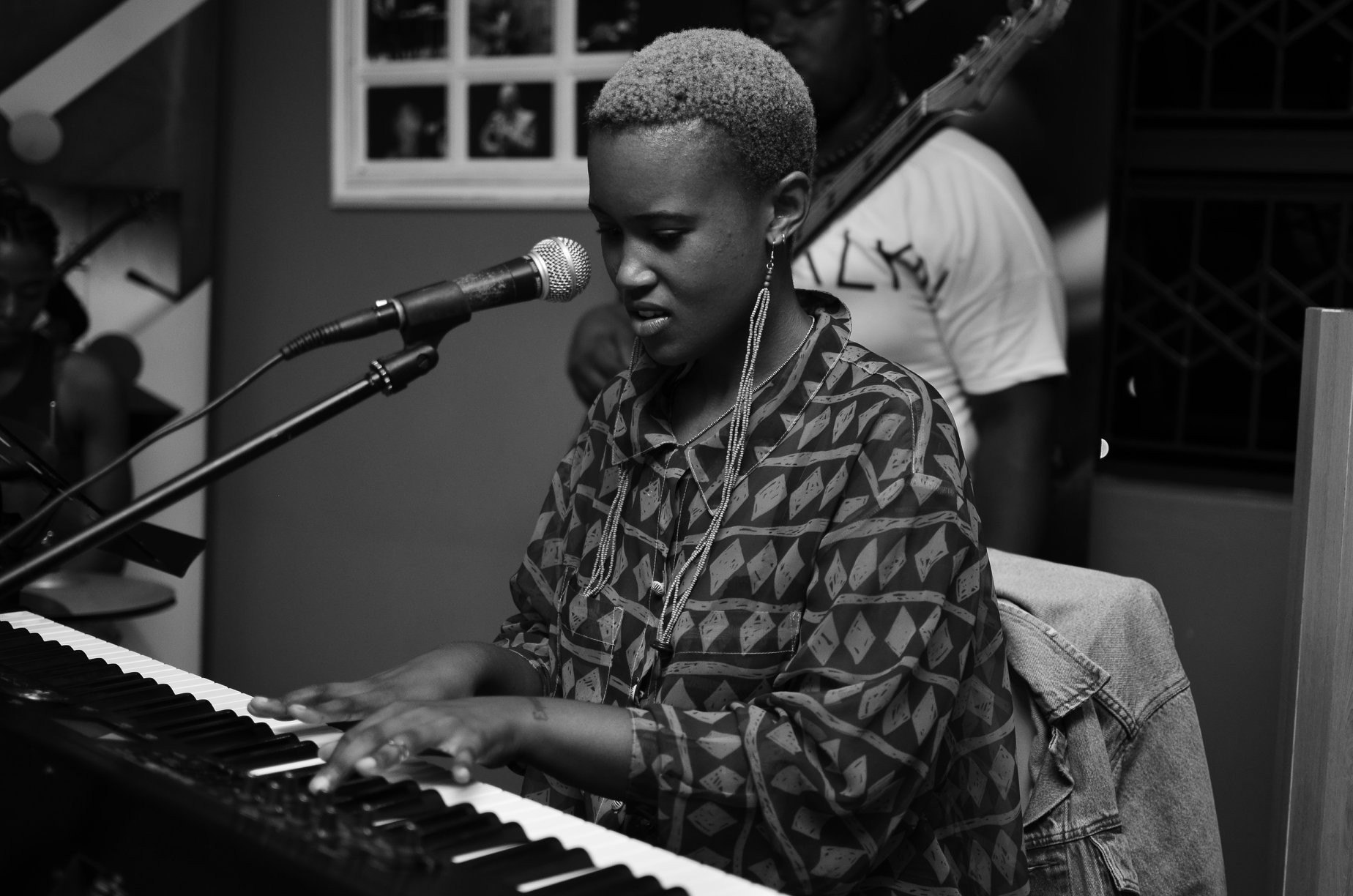
One of the most striking moments on your album is how you have chosen to introduce yourself and open the album in this childlike spirit through ‘Absenti (Intro)’. What does play mean to you and how is it part of your life’s journey?
I don’t take a lot of things too deeply. When I first hear the word ‘play’, what comes to mind is creativity. Because the album is rooted in Cape Town and my upbringing, that song felt fitting. It’s a beautiful piece, even the rhythm, the melody, and I was curious about what I could do with it using the harmonic knowledge I have. It’s a simple melody, but I wanted to reharmonise it and bring a different perspective into the album.
I also knew people would appreciate Absenti from childhood. It’s one of those songs we forget about, but when you hear it again it brings a whole world back to memory. I’m the kind of person who trusts ideas as soon as they arrive, and this was one of those moments; I thought it would be cool, so I did it.
I genuinely love the process of making music and putting harmonies, melodies, and rhythms together. The meanings come later. The art itself, the construction of the music, that’s what I’m passionate about.
For sure because do we actually know what Absenti means? I don’t even know what that actually is. Sometimes the essence of something becomes bigger than the literal translation or the direct explanation.
Absenti is interesting because, have you noticed how when we were growing up, we used to come up with our own scat syllables or made-up words to fit a song? Like when you’re listening to lyrics you don’t actually know, you just say something close to what you’re hearing. When you don’t know the words that well, you invent something that sounds right.
It’s the musicality of it. I think with songs of the same nature as Absenti, someone probably went with it once, and then we all went with it because, musically, it just made sense.
Isidubada does not sound easy at all. It’s also not lost on me that it’s a secretive Xhosa dialect that not all Xhosa-speaking individuals can grasp; simply those who get it, get it. What inspired you to include this linguistic layer, and how does it connect to the message or feeling you wanted the piece to convey?
There’s a singer who goes by the name Zimbini now. There was a group here in Cape Town called Lingua Franca and they were a poetry collective. They had two vocalists and Zimbini was one of them. They had this song… [continues to sing the song]… something along those lines. I never really knew what they were saying, but they did it in Isidubada, and I always thought it was such a creative thing to write a song in that style.
It ties back to what we were talking about, my childhood, my upbringing. Those little playful things really shaped my childhood. That’s why I thought it would be nice to include an interlude with Isidubada. My mother used to speak in that language sometimes. She’s actually the one who taught it to me. I think we were both bored one day, and she was like, ‘Oh, there’s this language…’ And sometimes she’d speak it with another relative so I wouldn’t understand — until she eventually taught me.
And yes you’re right; it’s very rhythmic.
And I’m also curious about the decisions one makes when speaking it; is Isidubada prescribed in any way? With language, there are grammatical rules and structures. So with Isidubada specifically, are there rules on where to place the ‘d’ for instance? Or is it more free-flowing and intuitive?
It’s actually really simple as it comes after every vowel then repeats the vowel it followed. So if it’s Hlengiwe, you’d place the ‘d’ after every vowel (and again add the vowel that the ‘d’ follows from the true word) and it would become Hledengidiwede. It’s actually very easy, even though it sounds complicated.
During my short time at UCT, I recall perceiving you as a slightly mysterious gal. I never interacted with you closely, but I was quite attracted to the poise you held. Can you tell me about the journey that led up to you deciding to specialise in jazz piano at UCT and if there were key moments while studying that affirmed this journey.
When I was in high school, I honestly thought I was going to be a chef. It was locked in my heart and I really believed I’d go into the culinary arts because I genuinely love cooking. I love the science behind it, how things come together.
But in matric, I went with my parents to Capsicum, that culinary studio, just to check it out. The deposit was huge; they wanted something like 50k upfront before you could even start. My parents were like, ‘We just can’t do that.’ So I had to rethink things.
I also really loved music. It wasn’t even a choice between the two; I loved them equally. So when the culinary thing didn’t work out, I thought, ‘Okay, let me just audition quickly.’ It was honestly last-minute because UCT’s closing date was the 30th of September, and I applied on the 28th or something like that. I auditioned, got in, and my life went in a completely different direction.
It wasn’t a deliberate decision. I just did what was in front of me with the talent I had. That’s how I ended up in jazz piano. I already had some jazz background through my father, and we had a bit of a big band at school too. Jazz piano felt right, especially because I didn’t want to do classical. I did classical in high school and wanted more freedom in my playing and composing.
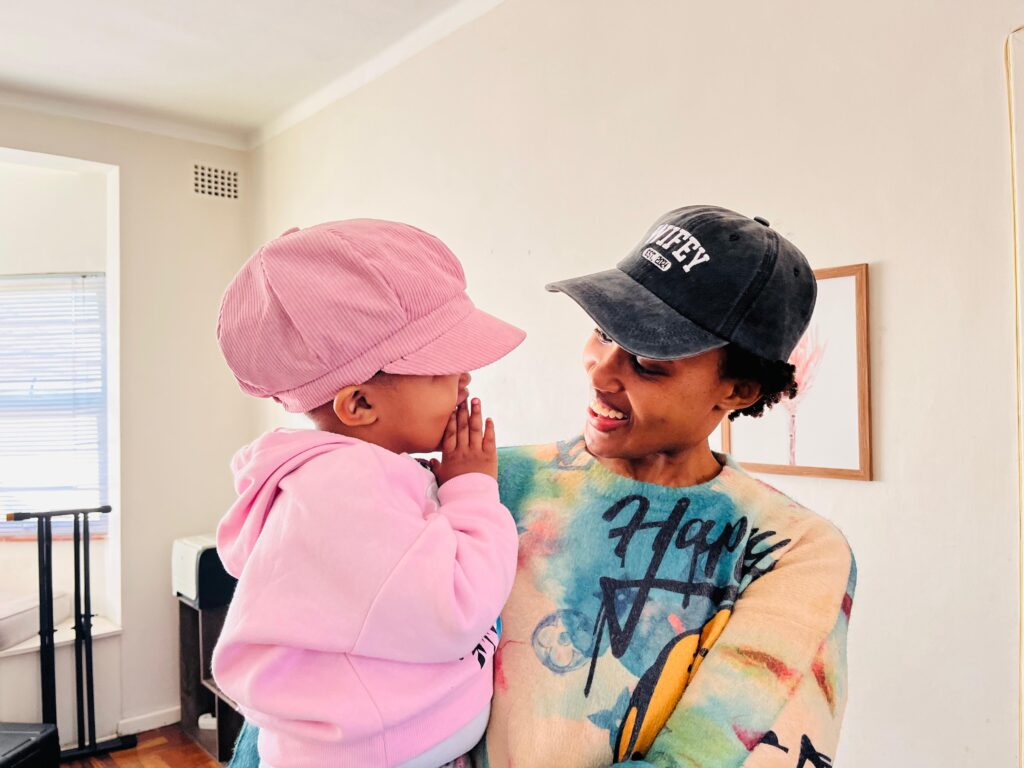
"Freedom is fundamental. Not just in life, but in how I raise my child."
In another interview you mentioned that your first real interaction with music was through the recorder, or was it a flute? And what really caught your attention wasn’t quite the instrument you were playing, but the teacher accompanying you in the background. It’s interesting how curiosity can redirect a whole life. You could have stayed with whatever you were focused on at the time, but your ear caught something else, and that pulled you in a new direction. To me, that feels purposeful and almost divine.
I have to say too, though, I grew up with parents who were very… I guess modern is the closest word, even though I don’t love that term. They weren’t closed off to giving me space to be who I am, and that’s something I think is incredibly important, especially for a Black child.
My parents supported me. Really supported me. I honestly can’t think of a time my mother ever shut me down for a decision I made. She always trusted me. I even wrote about that in the liner notes of my second album, because I’ve come to realise how deeply that shaped me. It taught me to think for myself. When I make decisions now, I don’t make them with my parents in mind and that’s how it’s supposed to be. You’re meant to be an individual, not guided by fear or by what other people might say. You stay open, and what’s meant for you finds you.
So even with music I told my mother I was done with the recorder. I didn’t want to play it anymore. And mind you, siseGugulethu and unlike what I saw with a lot of other parents in the neighbourhood, she didn’t force anything onto me. She just said, ‘Okay, fine. If you want piano, then let’s play piano.’
She taught in Khayelitsha — still teaches at the same school, twenty years later — and the school had a bunch of instruments no one was using. So she took one of the little Casio keyboards and brought it home for me. That’s when I started messing around on the keys. The following year, I enrolled for piano at my school.
My parents played a huge role in helping me become an individual, and in preparing me for adulthood.
And is that parenting style something you’re carrying forward now that you’re a parent yourself?
I learned a lot from my parents, but I want to be my own person, not a copy of them. I’m grateful for everything they did, but I stand as myself.
I do carry forward the part I see as fundamental for a child: the freedom to be themselves and speak up when needed. Of course, respectfully, but speaking up is essential. Freedom is key, and that’s very important to me as a mom.
Your YouTube channel also touches on what you do as a mom, which is teaching and imparting important skills and knowledge. The channel’s description is “I make the difficult stuff easy to understand, I think ❤ ️”, and there you teach piano methods, provide information of key tools musicians should have, and much more. What inspired you to teach music?
I’ve always had an innate ability, and maybe I can call it a gift, to explain complex ideas in a way that people can understand. Beyond that, there were things I didn’t learn in school that I wish I had, so I wanted to teach them. Honestly, it’s fun. I love creating. It’s not just the teaching, but the whole process of putting a video together, shaping concepts; it’s both for the teaching and for the joy of creating.
Now, having done it for so long, I’m also able to make it part of my business, so I get to do what I love and earn from it as well.
Two questions: is there a song you really love from the album, and which track was the very first one created for this project?
My favourite song would have to be iKhwezi. I just love the vibe it gives me. Songs usually make me feel like I’m in a certain place or time in my life, you know that feeling when a song transports you somewhere? Sometimes I feel like I’m in Paris, New York, or under a sunset. iKhwezi just gives me that sense of being in a place I want to be.
I can’t quite remember the very first song, but it might actually be iKhwezi. I do remember Langa Lam was one of the first, though. Leading up to recording the album, I was pregnant, and I remember writing Langa Lam during that time. So it would have to be between iKhwezi and Langa Lam, I’m not entirely sure.
The final track titled ‘A City Dream’ closes the album with swinging optimism and rhythmic sparkle. What is your personal City Dream?
It’s freedom and a first-class life [laughs].
I want to live in a free society. That’s also one of the reasons why I love South Africa. I love that it’s diverse; I love meeting people from different backgrounds. City life reminds me of that, it’s eclectic in that way.
What I really love about the city is that it creates a new culture. It’s not a place where you’re only surrounded by, let’s say, by amaXhosa, or only by amaZulu, or just Asian people. It’s a place where people come together and create new ideas, and that’s what it’s about. Culture back in the day was the culture of the time; the people created it. And now, people want to take traditions and meanings and bring them into the present, but the culture is in the now.
I love that city dream. It’s crisp, it’s at the tip of your fingers, creating something new in the moment. My city dream is to live a free life, a first-class life, where service delivery is on point, where life is easy, how God intended it to be, in a sense, where I think we were all supposed to live freely. And of course, making music and enjoying all of that as well.