“The stage is one end of the circle, the audience the other; it’s in that mutual recognition that the healing happening for me travels back to whoever my reflection in the audience is.”
– Vuyo Viwe
Written by Hlengiwe Mkwayi
Sometime towards the end of 2025, trumpeter Robin Fassie, posted a powerful black-and-white video of a soundcheck for a performance at the State Theatre. Fassie is in the foreground playing with earnest focus, and behind him, stands Thandiswa Mazwai, watching with a haunting and grounded stillness, her gaze on him as he attentively presses down on the trumpet’s valves. You can make out hints of other stage elements in the background, but the moment belongs entirely to the two of them.
This moment that Vuyo Viwe Tshwele is about to have on the Sankofa Heritage Fest stage feels very close to that moment that Fassie shared with King Tha; a recognition of a becoming, and an unspoken assurance of the musical terrain that the protégé is navigating, because she (Thandiswa Mazwai), once walked it herself.
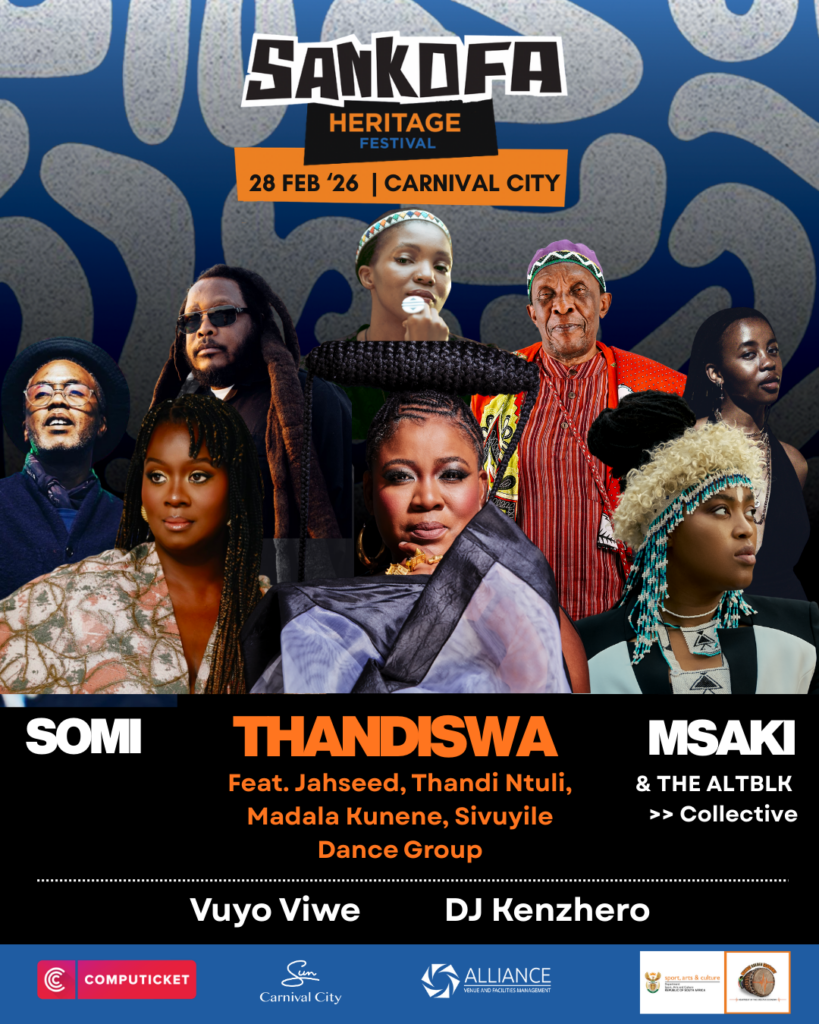
A winner from a selection of over 250 applicants across South Africa through the Opening Act Competition, Vuyo Viwe emerges from Johannesburg as an artist who is less interested in performance as spectacle and more invested in ceremony. The Sankofa Heritage Festival is a gathering devoted to indigenous sound, cultural memory and African lineage in celebration of Thandiswa Mazwai’s 50th birthday, and here Vuyo Viwe takes the first note of the night.

In the spirit of Sankofa, that being to go back and fetch it, what are you consciously carrying forward as well as reclaiming from your musical ancestry?
There are a few things I am borrowing from that will eventually be revealed in my upcoming album, but at its core is circularity. I talk about circles a lot. I find circles sacred, inclusive and traditional. I am drawn to how African architecture (kraals, kingdoms), daily occupation (calabashes, drums, meetings), fashion (the lines on umbhaco, the top of ischolo) and social life (choruses, ceremonies, drinking, mourning) and how they all lean on circles and circularity. That facing of self and other, always confronted with looking at someone else before perceiving yourself. Even with our music – it’s easy to think traditional song forms are repetitive, when really they’re cyclical. How we conceive of time and seasons is cyclical. I found that once I noticed this circularity, I began to notice it in most things that make me uMaHlongwane.
Therefore when I write, it’s not always a conscious thing, but I lean on cycles a lot. The concepts behind my songs kind of eat themselves, where the end is also the beginning; a perfect circle (or spiral, depending on your perspective). Tropic of Capricorn is one of those songs that has many layers, like a spiral (a spiral is a long line, as is a circle). I wrote that song while rafting down rapids close to the Tropic of Capricorn back in 2023. It had been raining, so the river was roaring. It also meant that it was so cold, cold enough that I could see my breath. I remember being so cold and irritated at the weather, before realising that the rain had made the forest foliage so rich, lush and green that I almost wanted to lay down and sleep in it.
The bassline kind of fell on my head. I don’t remember any of the conversations I had that day. I just remember singing that cascading horn line the rest of the day, and for a month or so after that. I didn’t realise what it was at the time, but the water meant a lot to me that day, its the reason why I wrote the overlapping horn lines and the kind of tinkering piano lines. Fast forward to 2025, and in passing, my dad let me know that I come from a lineage of people who healed with water. His dad and grandfather would be tasked with healing in the community. Its how they earned their living. AmaNgwane are known as water people. I guess that explains why I was so affected that day by being both in water and feeling the rain on my face. I’d always thought I was the first therapist in the family but I’m realising I’m just a retelling of a familiar calling.
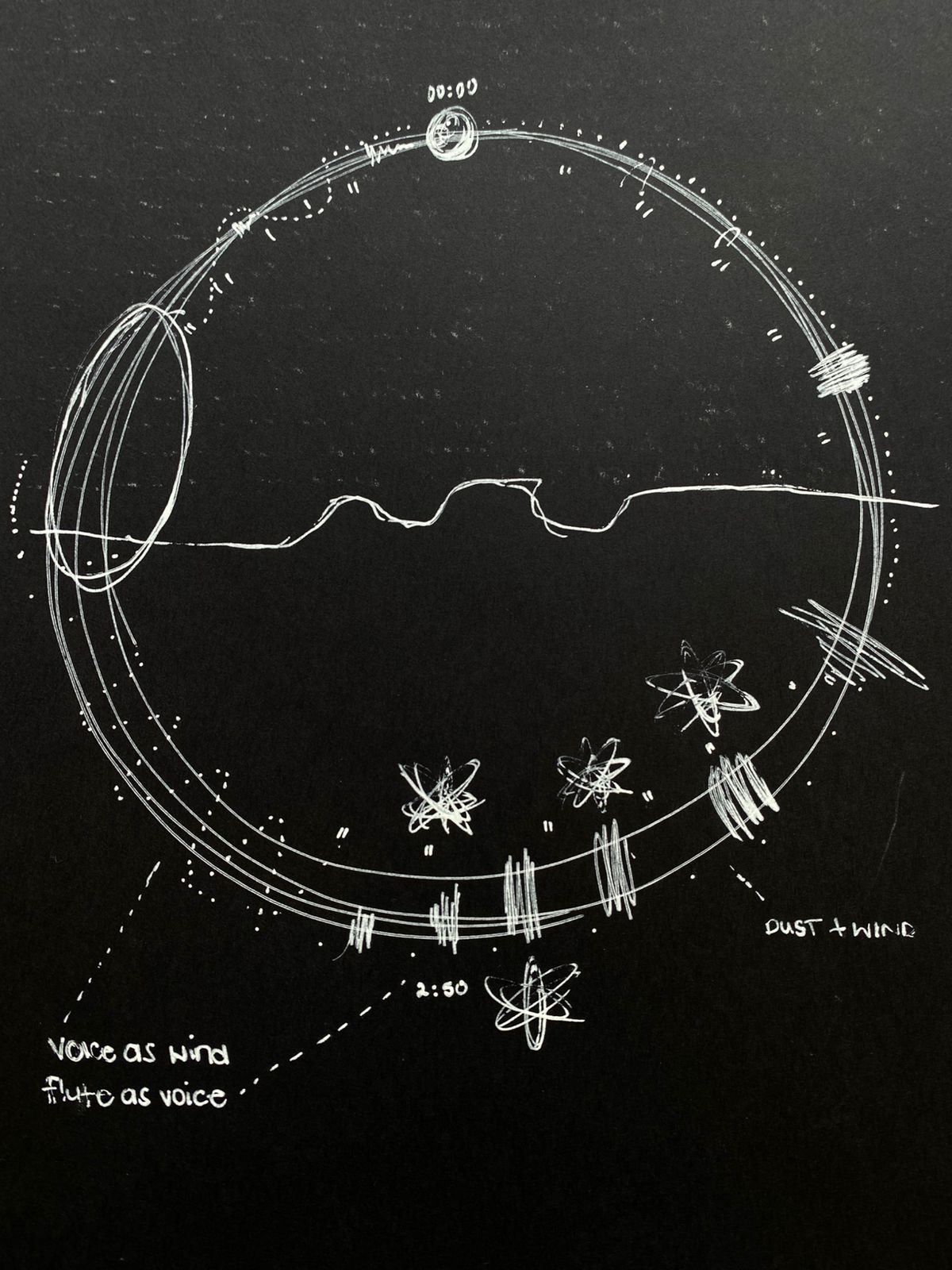
On a more meta level, I’m really invested in Southern African methods of history keeping and storytelling. I’m always going on about how we have a wealth of history, we just haven’t been taught how to “read” it. Rock paintings, the significance of the colours of beads, oratory etc… we are a very creative people. So even in my creating, I use my voice to sing all the instrument parts before coming back to Western notation/ instruments. In my archiving, I have been playing around with graphic notation, where the music is always represented in a circle and only density is notated, not key or tempo. In my head, it means that my music can always be re-created to feel the same as intended, even if it doesn’t sound the same. WIth time, I would want to hear what musicians play when they read my graphic notations, more than a reprising of what my band has already done.
Who and/or what nurtured your musical gift?
This is layered, I think. On one level, my parents helped me with music lessons, took me to performances and understood that I was going to study music. On another level, my childhood best friends and teachers witnessed and encouraged almost every version of musician I’ve been thus far (I started out as a pop-RnB girl, imagine!) But on a deeper level, I don’t think I ever really had a choice.
My brother and I would stay up to watch the Grammy’s or MTV VMAs, anxious to see who would perform, how they’d perform and then we would spend the week learning the arrangements and choreography. I think being exposed to performances kept reminding me of how badly I wanted to be on stage performing my music with the stages I dreamt up. I think I even went through a mashups phase because all the performances I was consuming on repeat had some kind of mashup element. The artists of my childhood have kind of followed me into adulthood, and they all make me feel like I need to keep going until I get where I always dreamed I would.
You’re moving toward music therapy. How does healing show up in your performances as well as your music compositions?
I sat on this for quite a while actually. I always knew that I wanted to heal people no matter what I do, but as I made my way through the Master’s I realised that was a really egocentric perspective. I don’t set out to write “healing” music. I don’t even write with any cathartic intention. I only write when a song arrives, and then I sit and make sense of why it is. I think its because the compositions serve me and they resonate with people watching. I think the healing comes from people watching a kind of healing unfold in me, and that’s what connects.
I’m not sure I have the power to be the architect of healing music. I think it just does because it just is. And maybe in the spirit of circularity: the stage is one end of the circle, as is the audience. I can only see myself by looking at the audience as they digest me. Its this mutual recognition of the other that transmutes the healing happening for me back to whoever is my reflection in the audience. That, and cyclical writing. A lot of traditional music draws its power from repetition, from revisiting. The more we sit on a powerful progression or motif or melody, the more we are affected by it. In every performance, we repeat these moments until we can feel that it has nothing left to offer. That’s also how I decide a song has ended.
From my first experience seeing you live kwaMamakashaka to your upcoming performance at the Sankofa Fest, you have a steady band you’ve been performing with. What has been your approach in choosing collaborators to create with?
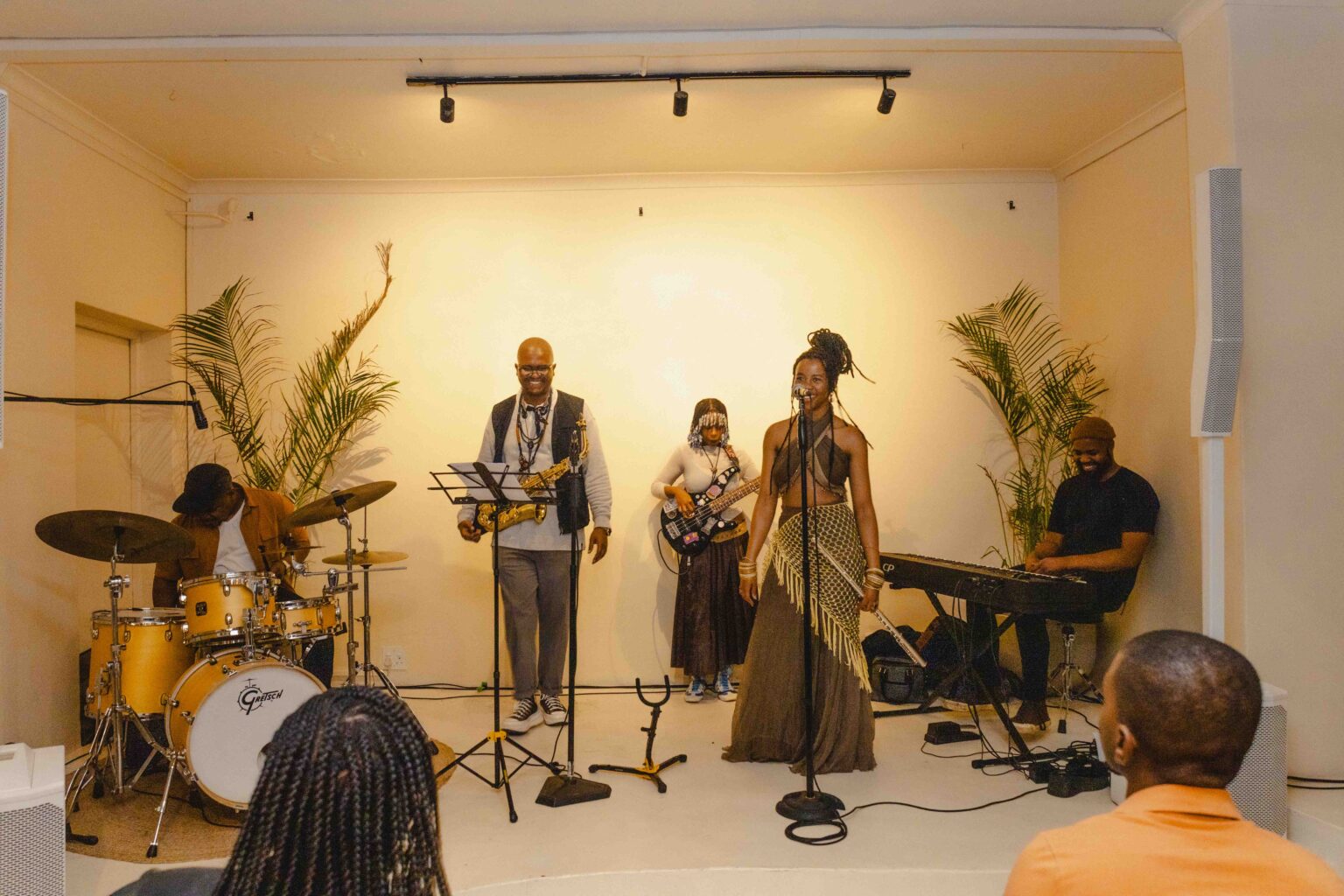
This was an agonising process! I maintained from the start that I didn’t want to curate a band based solely on skill, but rather on spiritual openness. I chose my band based on how their playing had made me feel at each of their performances, even if it fell outside of Jazz, if I can even call this Jazz. When I approached them, I let them know I had been drawn to their craft but also their heart, and that I would need for them to really see my music as prayer/ritual/movement/refreshment more than a gig. I was lucky that they all agreed. Even with future collaborators, I have my eye on people whose energies I really enjoy and respect. I think it’s what got Team VV to sounding so warm just a few months into the work.
Making music is a mission, because at the end of it all, I needed to balance my means with my dreams. In my head, my band includes a Baroque orchestra and an uhadi choir. But we’ll get there!

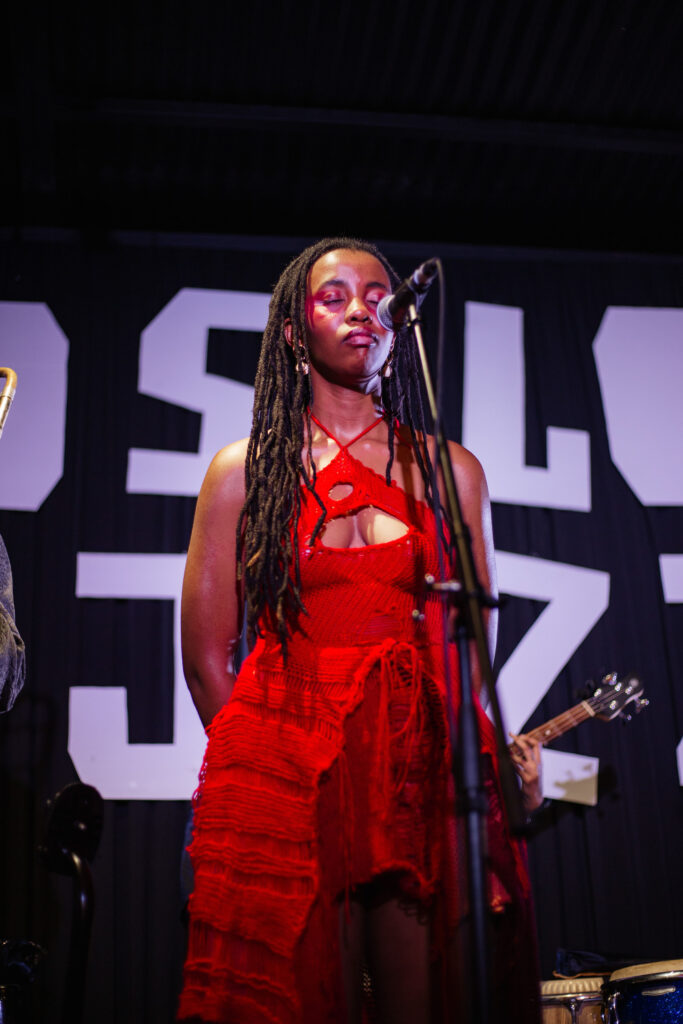

What does your morning routine or daily habit look like?
You know, at the end of 2025 I decided that I wanted to understand Zimology as a practice more deeply. So I fasted, I walked, I journaled, I recorded, I read. I really listened to Zim Ngqawana’s music a bit more intensely. I realised that he was saying in order to music, you need to be clear with yourself as a vessel, as the primary instrument before the instrument you play. So I came out of that fast with less routine, but more clarity.
My morning can look like anything but I always start by sweeping. Its like a concrete clearing of my mind and space. I sweep, I journal, and I ask my ancestors to sing through me. That’s the exact request. Everyday. I don’t know how much more I have to learn, but I am getting used to this deep self-confrontation. Like, how can a song find me if I haven’t cleared my space and reset my senses? How will I refine my sound if I don’t learn to sit in the discomfort?
Has there been a time when you had to reintroduce yourself to yourself, when the woman you were becoming surprised even you?
Back to circularity, I have to say I don’t ever feel like I move on from a sound or a version of myself. It’s more like those Russian Matryoshka dolls, where all those versions are with me all the time and they are just as whole as the other. Musically, I love that I can kind of feel a little bit of all the genres I love and listen to. It’s like, 12-year-old Vuyo is there when 20-year-old and 25-year-old Vuyo are creating something. It feels like I insist upon myself, even as I “deviate” from my pop/Western classical roots.
I can say though what really always surprises me is my writing style and what it produces. I never sit down with the intention of writing, so if I am not honest and cracked open enough, nothing arrives. During my fasts I think I am most creative, because there is kind of nothing there. It’s just me and my fortitude. It feels very…concrete. Like, I am Vuyo, I am really alive, I am really a human being. And it’s when I get that clarity that I grow a little. In the last year I learned though that my anger is really powerful. There is and was so much of it that it was kind of distracting. I decided to do a long fast, and at the end of it I was really sure of the people I wanted in my band, the next song I was going to write and the story of my album. I met myself again, and learned that I can honestly do anything as long as I learn to alchemise. Energy is energy, you know? Anger and motivation can be the same thing if I let it. Sadness and surrender can be the same thing if I let it. I think that was the proverbial frontal lobe finally connecting its dots at big 25.
What do you want the audience to experience seeing you perform on Sankofa Heritage Fest stage?
I won’t have much time, but I really hope that I can feel my heart. Every version of myself has willed this day into being. I hope the colours, the sounds and our energy translate. We pray together, we laugh together and by the time we perform, I hope the audience really feels pulled into the honesty of the music we will make. The colours and textures I’ve chosen go back to themes from home: money and wealth (of knowledge). The set list also tells the story of water, renewal and Nature. I hope at the end of it, they want to hear the rest of this story – my story.
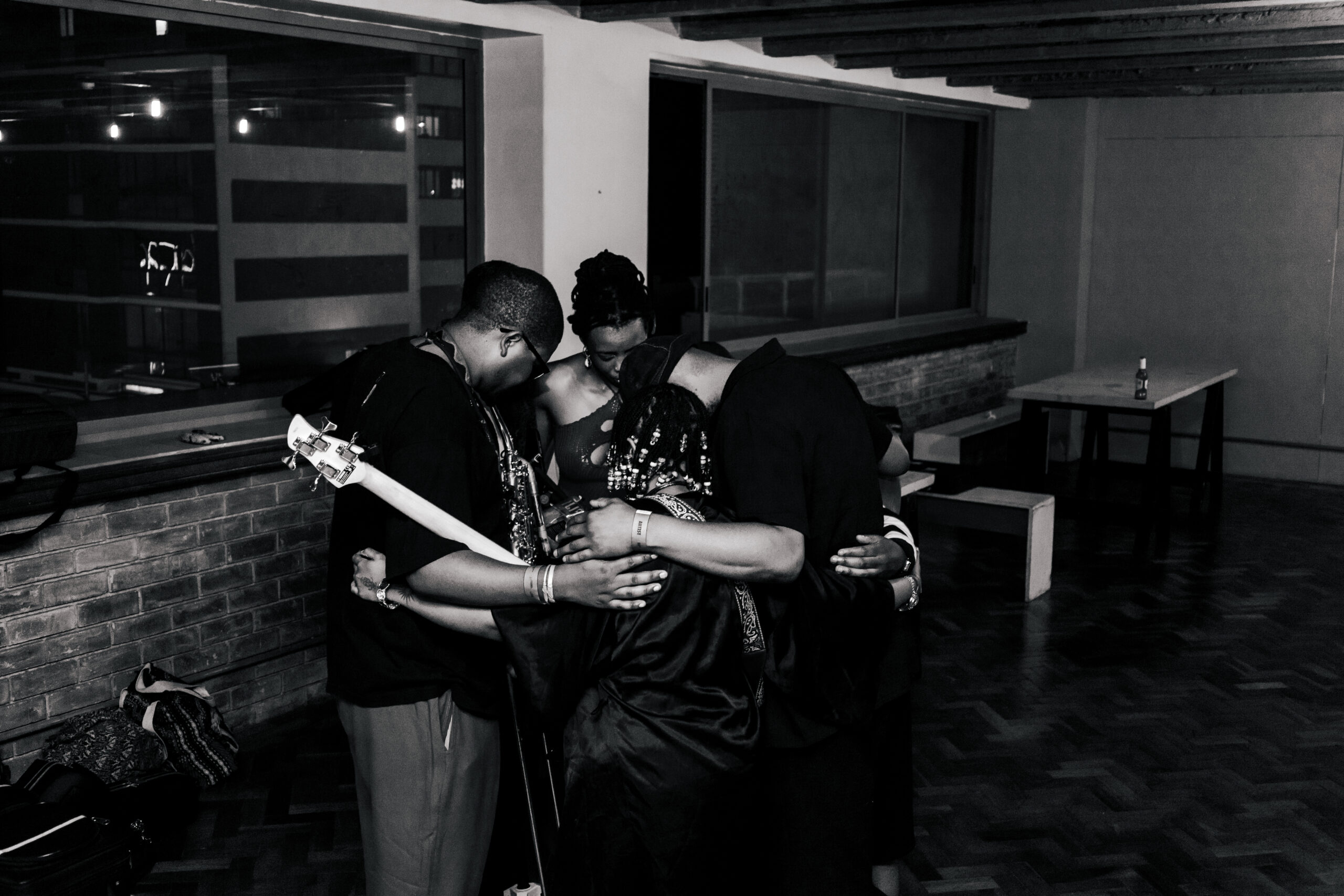
Vuyo Viwe joins a constellation of artists bridging generations and geographies, set to be performing at the Sankofa Heritateg Festival.
Alongside Grammy-nominated Somi and South Africa’s own Msaki, both long-time collaborators and creative sisters to Thandiswa Mazwai, the evening will also feature the genre-fluid brilliance of pianist Thandi Ntuli, the revered Zulu guitar custodian Madala Kunene, and Jahseed of the iconic collective Bongo Maffin. With the Sivuyile Traditional Dance Group grounding the stage in embodied Xhosa expression and DJ Kenzhero curating a closing selection of South African sounds, Sankofa becomes a living archive.
In this gathering of elders, peers and future voices, Vuyo’s opening notes do not stand alone; they announce the arrival of a new chapter in an ongoing African sonic lineage.