Thinking about what the South African dream was, is, and could be.
Written By Tshiamo Mangwedi

Growing up I used to look forward to school holidays, mainly because I would get a well-deserved break from early mornings and strict bedtimes. But also because I would get to visit my great-grandmother and great-aunt in Meadowlands, Soweto. A township known for its people, history, music, vibrancy, culture, and for a period in my life I knew it as another home.
Visiting Zone 8 meant a break in routine, endless playtime and most importantly freshly baked scones that my sister and I would have on our arrival. It was mamane’s loving tradition to bake scones whenever we would visit. And I always knew they were made with the highest level of consideration because she would make a little baby scone just for me – cuteness overload, I know!
Like many kids who grew up in the township or township-adjacent areas, the street was our playground and our first classroom for social interaction. It’s where we made friends, where we had fun, where we began to conceptualise the idea of community, where we fell and hurt ourselves badly, so much so that we would run back home face filled with tears and snot, in search of motherly comfort. And once comfort was restored, we would go back to the street because that was our third space.
Our parents would use the street as a place to meet and commune with neighbours too; a regular occurrence of this which i witnessed each time i was in Meadowlands was when everyone would fetch their purses tsa Mo-china or fafi. And occasionally the street would be used to celebrate and grieve, this would be marked by a big tent set up in the middle of the street.
Now you are probably thinking why am I telling you this? Or better yet, what does it have to do with cities being reimagined? I share this because those are the memories my brain reached for while standing on Bree Street recently with Phano Liphoto, an urban planner and member of Young Urbanists, looking at South Africa’s first street experiment.
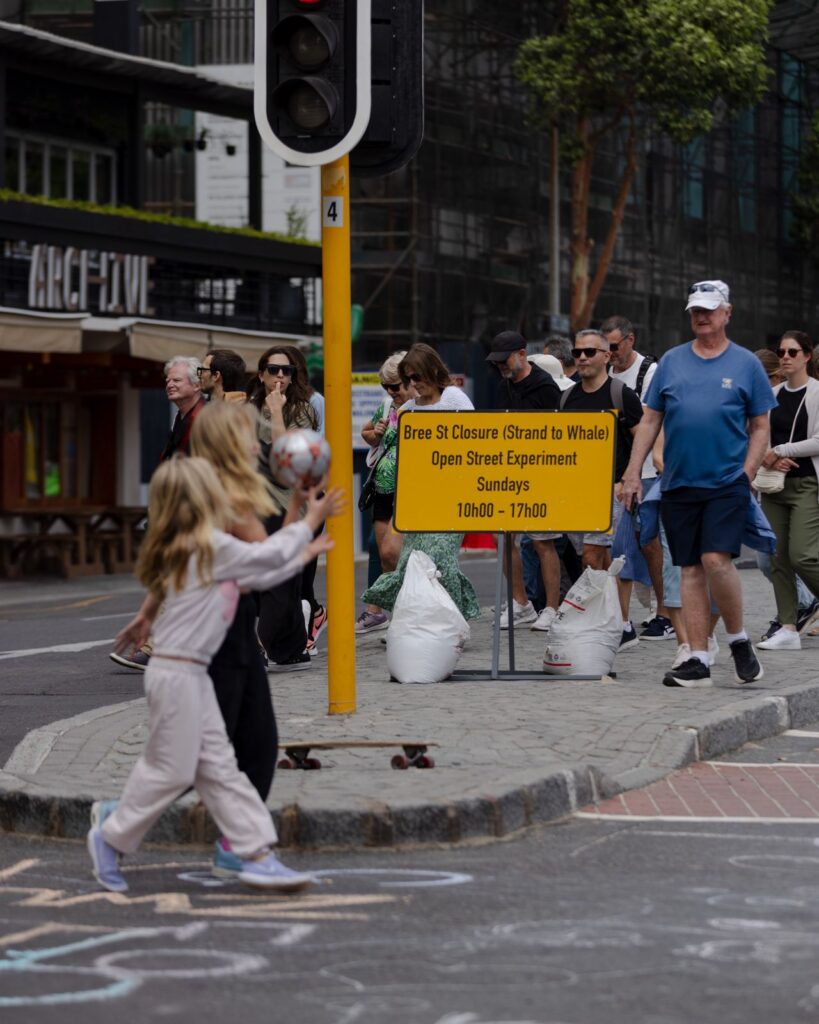
Founded in 2013, Young Urbanists began as a platform to bring people from different walks of life who are interested in shaping better South African cities together. What started as a space for open dialogue and exchange grew into a national movement with different programmes, partnerships and on the–ground projects and programmes that test ideas in a real-life setting. One of them is the Bree Street Experiment.
Pioneered through the Safer Streets Programme and the Urban Design and Mobility Forum, in collaboration with the City of Cape Town, the Mayor of Cape Town and Urban Mobility. The programme changes the road space with the help of temporary delineator kerbs and bollards to one mixed traffic lane in each direction, between Wale Street and Shortmarket Street, and converts some parking bays into formalised loading zones and increases pedestrian space by adding detachable seating and landscaping elements as well as street art by local artists.
“These aren’t just there (delineator kerbs). But if you take a look, if a car was to want to turn left, it’s gonna go a little further than it would if there was no cone there, you know? Meaning the smaller the space there is to turn, the slower you have to go – slowing down streets for people. The lane reduction we’ve done here. Lanes are smaller, meaning there’s more space for people less space for cars, cars (drivers) have to be much more vigilant. The trees also play a significant role in reducing the visual of the driver. So, they can go okay i need to pay attention now, the road is smaller. There’s people standing close by. “
Phano explains that all these changes are made to intentionally make the street more people focused than car focused. By opening up the street not only does it create physical space, but it creates space for people to feel safe, and for people to have a place to commune and connect.
Ultimately, creating a third space for people.
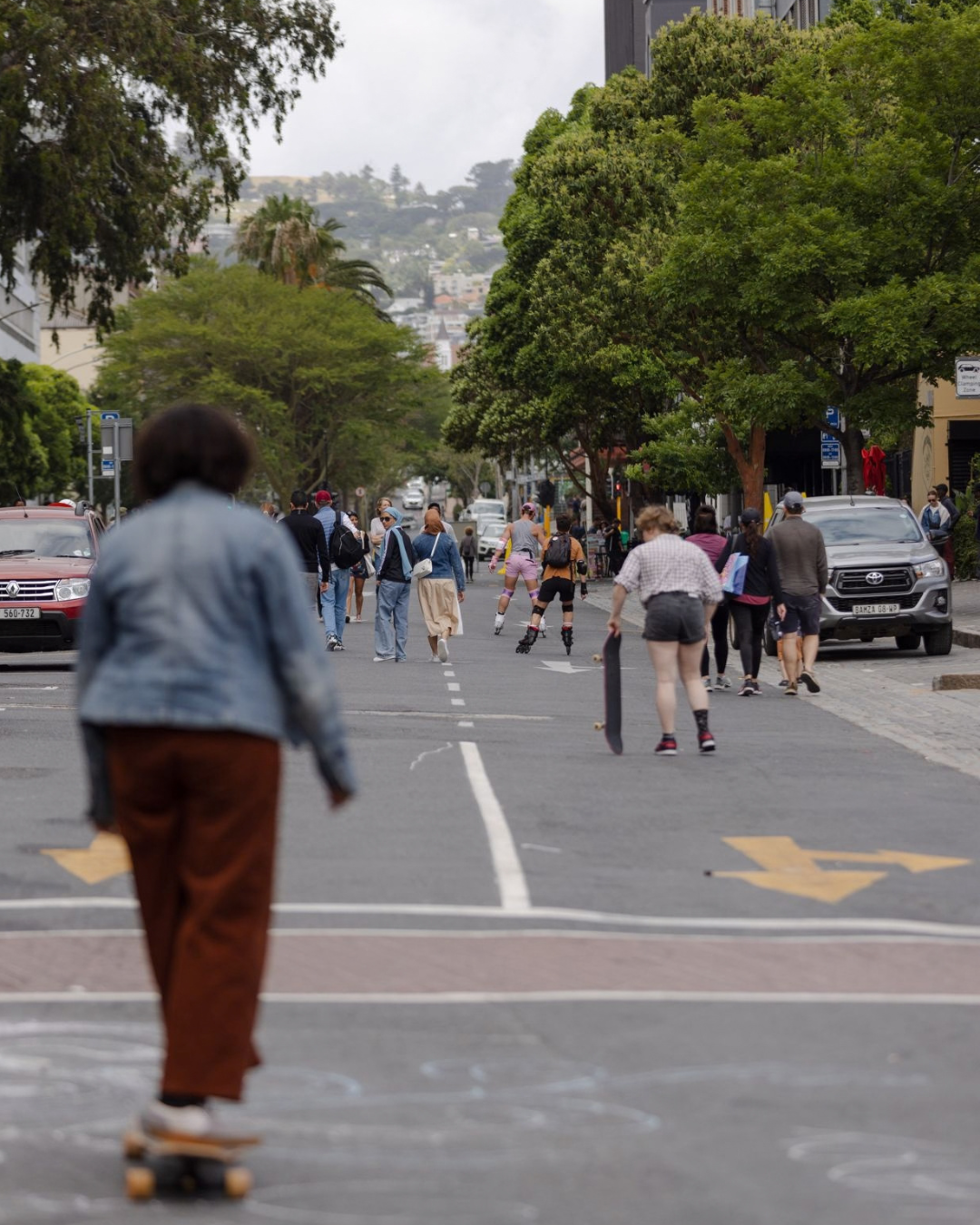

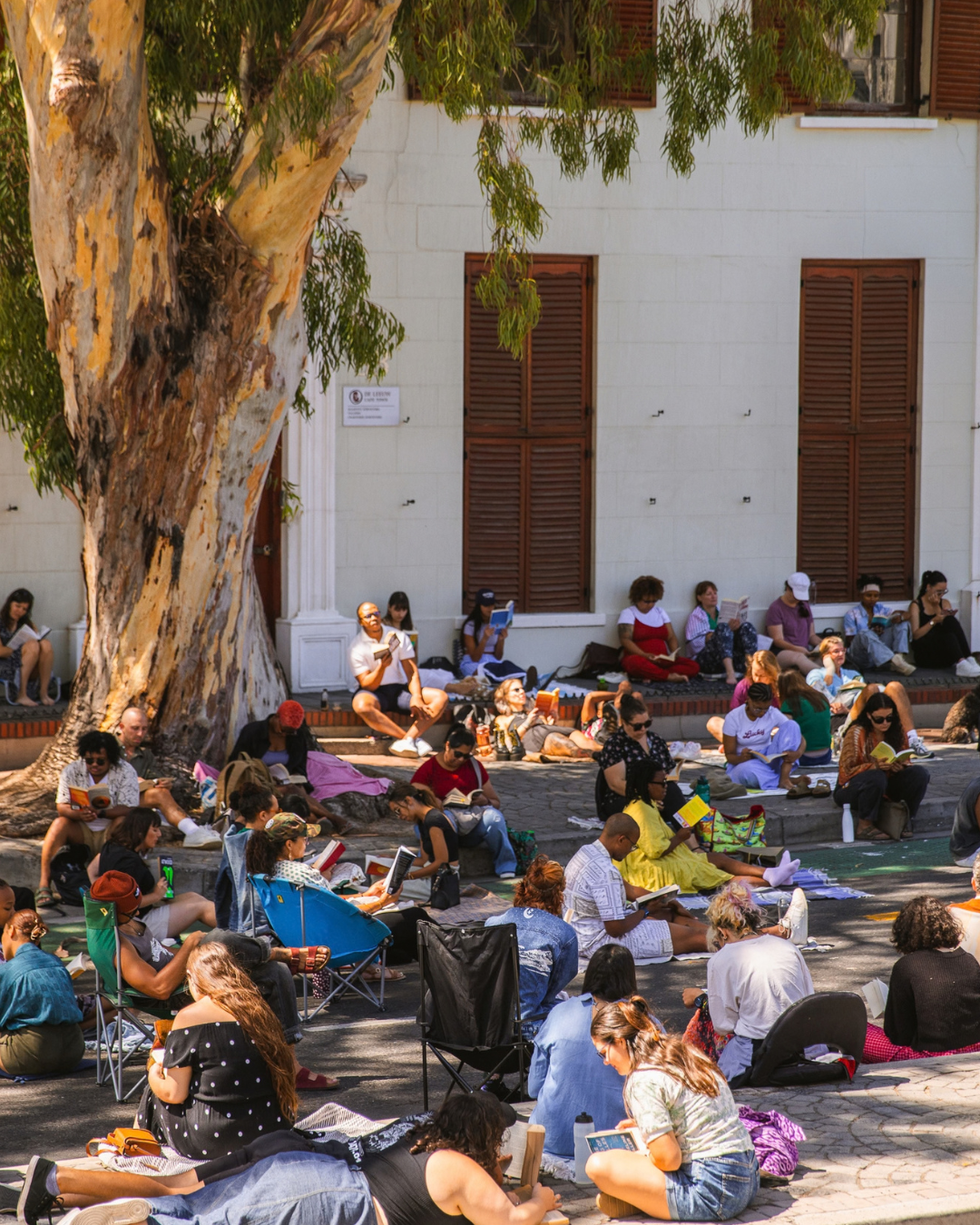
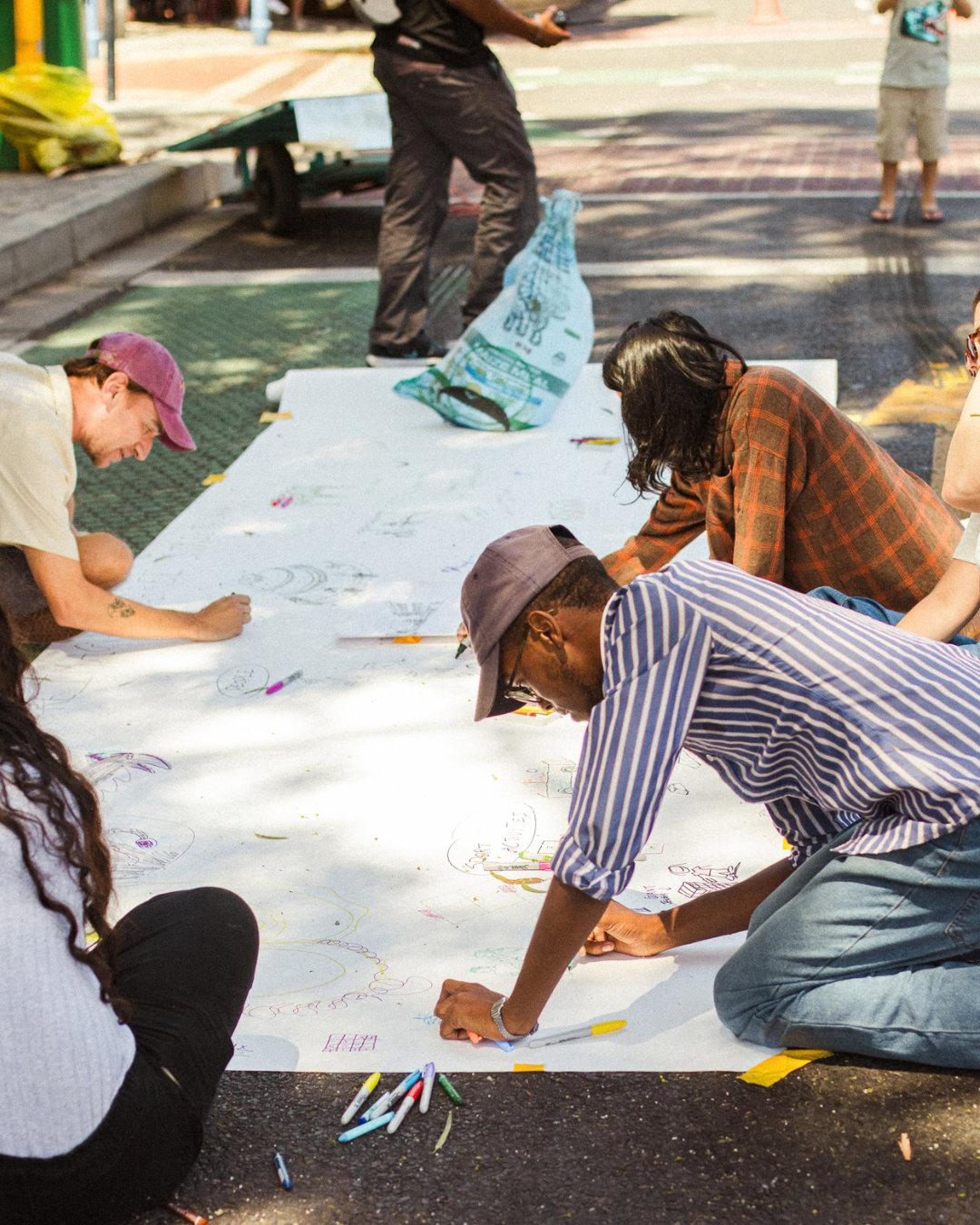
“The big thing we are trying to challenge is ‘what is the South African dream?’ Is it an American dream? How boring! It’s not another mall or what designer brand you wear or what car you drive. That’s not our vision of cities or what South Africa should be from an identity perspective. It needs to be cities with public spaces, and we could argue that as a form of decolonisation.” Says Roland, urban planner and Managing Director of Young Urbanists.
“Back in apartheid, the National Party looked at America in terms of growth and development: the highway, suburbia. And obviously we added apartheid spatial planning to that. If you look at how communities are divided, they are divided by highways and rivers that have been channelised. And even to some extent that happens in America, where communities of colour were divided by highway building. So apartheid is obviously a different form of colonisation and a different form of dehumanisation. And it goes far more deeper. But from a building perspective, that is the same pattern. That’s the same tool, and we are trying to change that.”
Roland goes on to express the importance of the Street Experiment as well as Open Street Sundays. “We only get to interact with one another when we share a taxi or train. Otherwise, the only other interaction is when we render services or see each other in a mall. So, it is quite limited. But in a space where there is more diversity, people can open up businesses. I mean if you go to the mall it’s the same offering. And what we are saying is we need to create more public spaces for people and that’s how we can integrate more, understand each other more.”

My conversation with Phano and Roland left me thinking about two things. The first being that I have gained more perspective and learnt things that I never imagined I could just from being in a casual setting with people. The second thing is that good urban planning doesn’t sit isolated in its own vacuum. It intersects and engages people, culture, and historical context.
And perhaps that is what stayed with me. The realisation that good urban planning is never just about roads, buildings, or where we place a tree or monument. It is about people. It is about culture, memory and the small, everyday interactions that make a place feel like somewhere you belong.
My memories of Meadowlands, together with this conversation, reminded me that the street has always been more than a route from one point to another. It can be a playground, a meeting place, a place to trade, celebrate, grieve, connect and simply be.
Maybe reimagining our cities means looking back as much as it means looking forward, recognising the ways in which South Africans have always created community in the spaces around them and asking how our cities can make more room for that.
Maybe the future of our cities isn’t about building higher or driving further. Maybe it’s about making more room for each other and finding new ways to express ubuntu.