
Freedom Is Not Inherited, It Is Remembered: Studying Under the Barrel of a Gun
Written by Renaé Mangena
This is the second time I have written about Tebogo Malope’s work and a first for me to revisit a director’s work and write about it twice without ever having shared a conversation with them. Usually, me writing about a filmmaker is accompanied by some form of exchange, a meeting of minds that helps illuminate intention. Here,I only have the work itself. Yet perhaps that is enough. Perhaps the most profound conversations are the ones we have with the work itself.
I was having a hard time trying to figure out how I go about this piece, where do I start and where will it take me, so I did the most reasonable thing I could do, I went to substack and started reading about everything but films which lead me to a substack written by Colin Bodayle titled The Principle of Hegel’s Dialectical System and here I revisited Hegel’s Dialectical System: the idea that history, consciousness, and reality evolve through tension and contradiction. A thesis gives rise to an antithesis, and from their collision emerges a synthesis of a new understanding of the world. It is a useful framework not only for understanding the film, but for understanding South Africa itself.
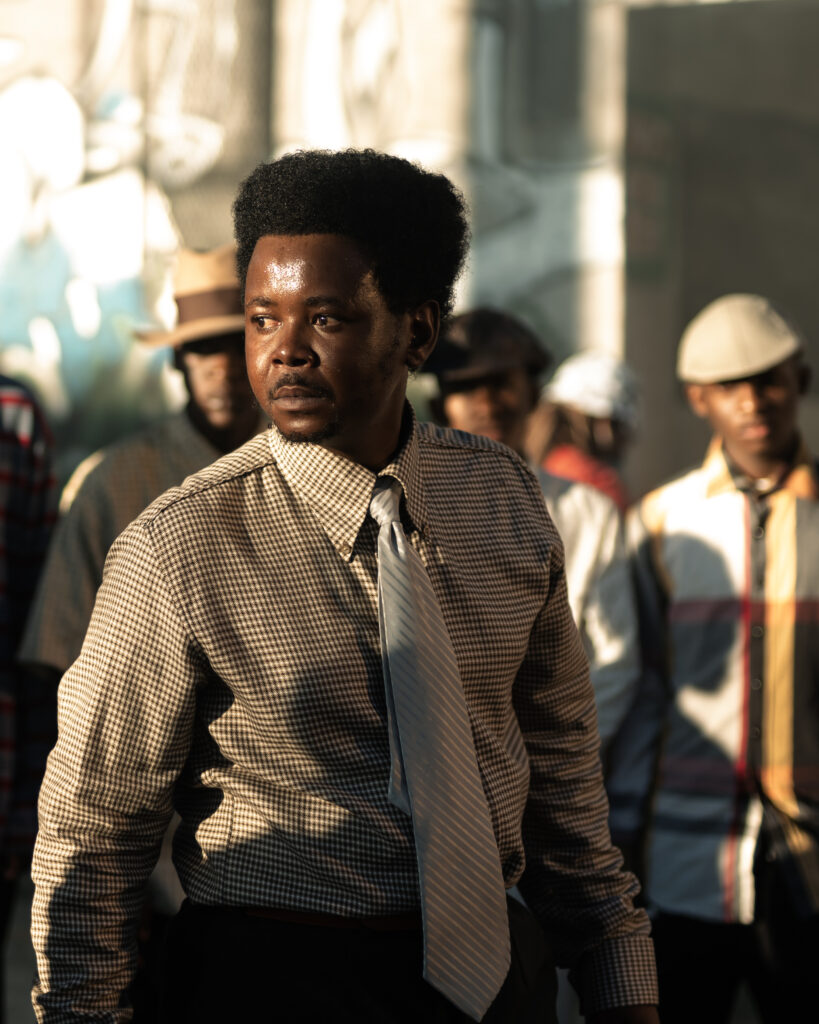
Adapted from Ernest Khosa’s book of the same name, Studying Under the Barrel of a Gun transports us to the University of the North (Turfloop) in Limpopo during the final decade of apartheid. The film traces a history that many South Africans know too little about: a history of student resistance rooted in Black Consciousness, shaped by the influence of SASO, and inspired by the enduring legacy of Onkgopotso Tiro. It follows the events that culminated in the military occupation of the university on the 12th of June 1986, when apartheid soldiers invaded spaces of learning and transformed lecture halls into sites of surveillance and fear.
Yet this is not a story about armed struggle in the conventional sense. It is a story about strategy, conviction, and collective imagination. Through underground networks, churches, student organisations, and communities, resistance is cultivated as both a political and spiritual practice. Arrests, solitary confinement, intimidation, and violence become part of daily life. And still, the movement grows. Students, workers, parents, and international allies unite in pursuit of a singular objective: the removal of apartheid troops from campus.

Their victory arrives. But history, as it often does, refuses to end neatly. When Nelson Mandela is released and arrives preaching reconciliation and negotiation, a new question emerges one that sits at the heart of the film: What becomes of revolutionaries when the revolution begins to conclude? What happens to people whose identities have been forged in resistance when the world asks them to become architects of peace?. For those of us who come from the North, the film performs another important function. It restores memory.
The historical imagination of South Africa often feels geographically uneven. Johannesburg, Soweto, and Cape Town occupy a dominant place within our national consciousness. Their stories have become shorthand for the broader struggle. Yet sometimes one could be forgiven for believing that apartheid never reached the furthest corners of the country.
Malope’s film reminds us otherwise.
It reminds us that Limpopo produced its own heroes, its own intellectual traditions, its own songs of resistance. It asks uncomfortable questions about remembrance. How much do we truly know about those who came before us? Do we know what they believed? What sustained them? What sacrifices did they made? More importantly, do we care enough to preserve those narratives?

In many ways, this is where the film finds its greatest strength.
Malope approaches history not as an archive to be dusted off, but as a living testament. Through a visual language that is both deliberate and deeply considered, he reconstructs a world with remarkable precision. Every frame feels rooted in a specific political and cultural moment. Watching the film, I was reminded of characters in The Black Power Mixtape 1967–1975 is a 2011 Swedish–American documentary film directed by Göran Hugo Olsson, except this time the geography shifts northward. This is not America. This is not Johannesburg. This is Limpopo. And Malope understands that specificity is what gives history its texture.
Within Hegel’s framework, the opening of the film becomes the thesis: the world as it exists. Students navigating university life. Friendships, ambitions, intellectual curiosity. A generation imagining its future.
The antithesis arrives through occupation and repression. The contradiction becomes unavoidable. The state imposes itself upon the lives of young people, forcing them to confront questions larger than themselves. It is here that the characters become most compelling not because they are heroic, but because they are human. They wrestle with fear, uncertainty, loyalty, and responsibility. They embody the difficult process of becoming politically conscious.

The synthesis, however, is not presented as a neat resolution. History rarely offers such luxuries. What I find most remarkable about Malope’s work is his ability to understand the urgency of timing. Great filmmakers do not simply tell stories well. They tell the stories that need to be told when society is ready or perhaps unwilling to hear them.
At a time when collective memory feels increasingly fragile, “Studying Under the Barrel of a Gun” insists on remembrance. It insists that the stories of the North matter. That archives matter. That the lives of ordinary people who participated in extraordinary moments of history deserve to be preserved. And perhaps this is the deeper gift of cinema itself. That is why this film feels important. Not simply because it tells a forgotten story, but because it reminds us that freedom is not inherited; it is remembered.


