


What If Braids Could Heal Us? Creative Director Asia Clarke on creating Ama’s Salon
Interview by Anastatia Nkhuna
What if braid-ups could heal us? What if beauty rituals could reconfigure memory, spark joy, or awaken courage? And are the risks of sharing our brain data worth the promise of mental health?
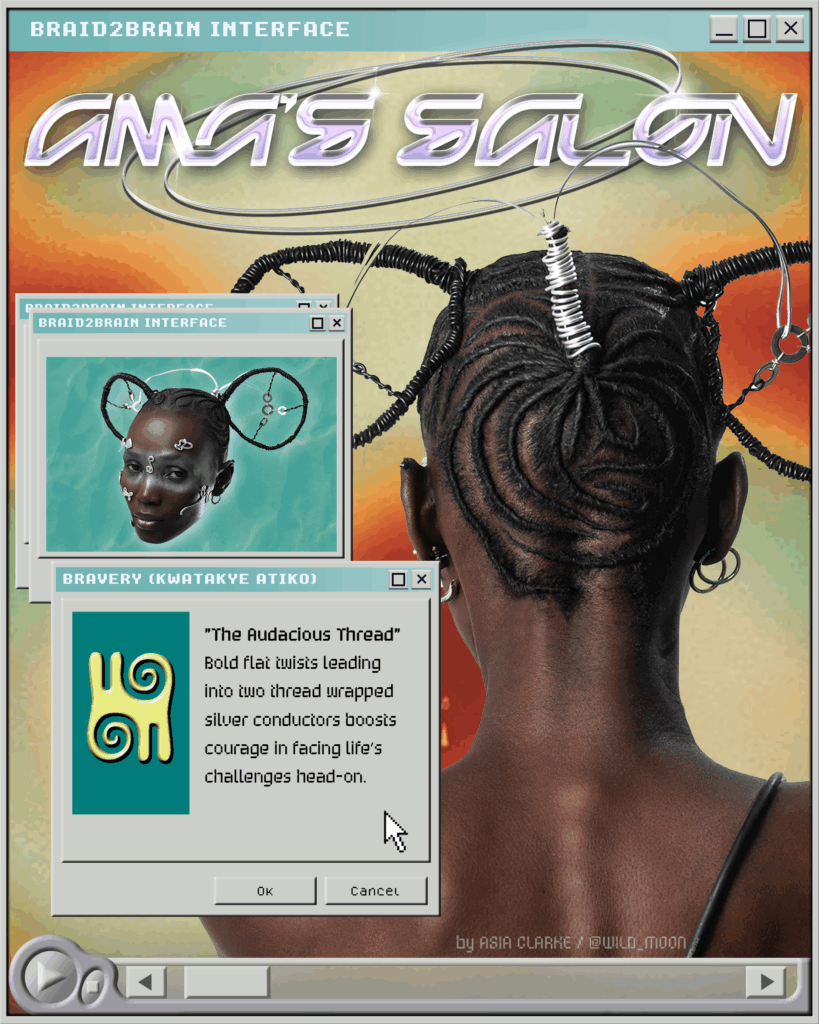
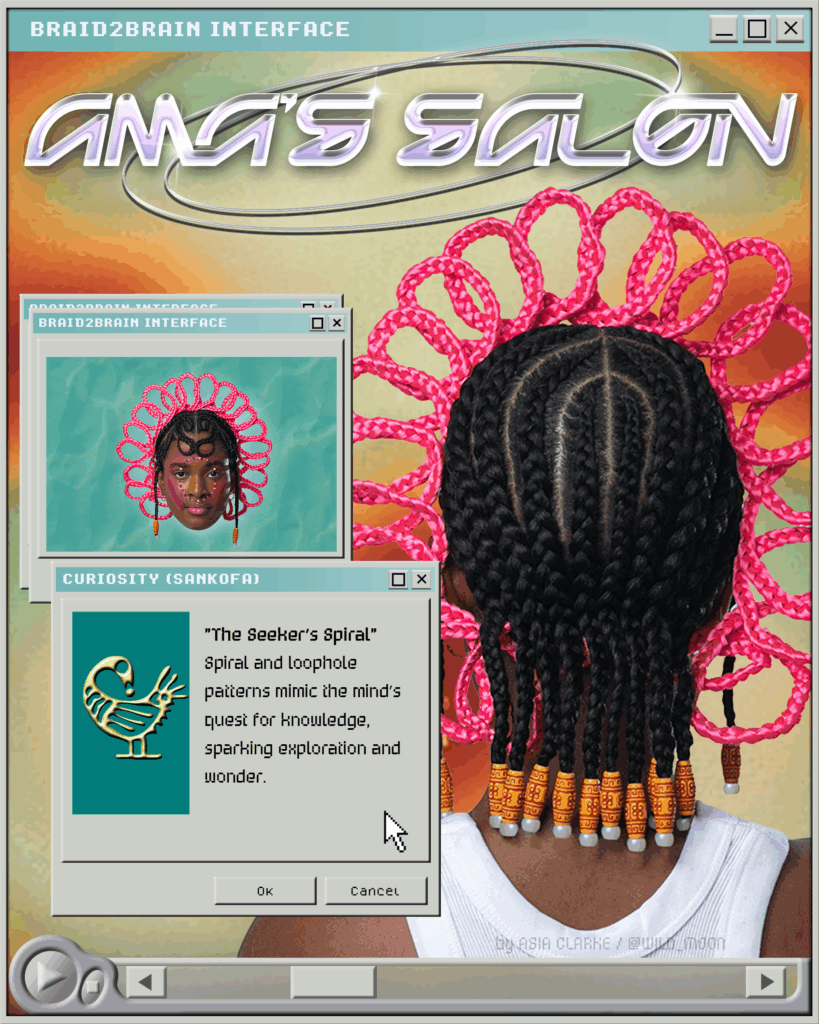
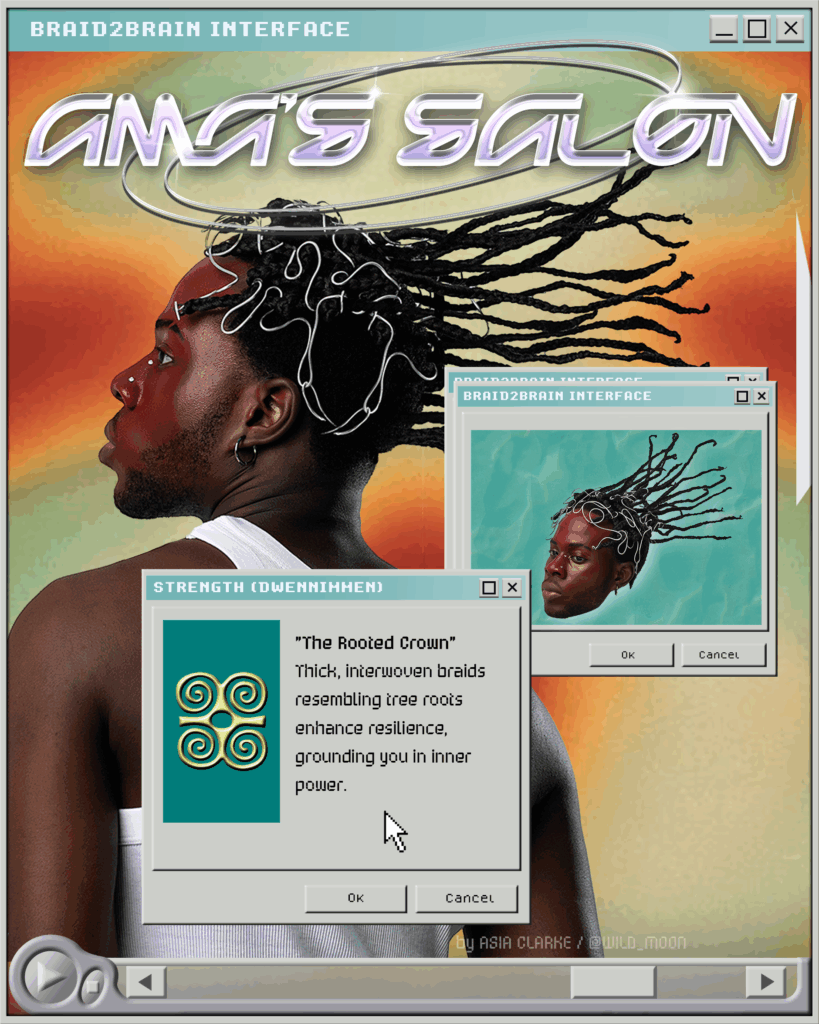
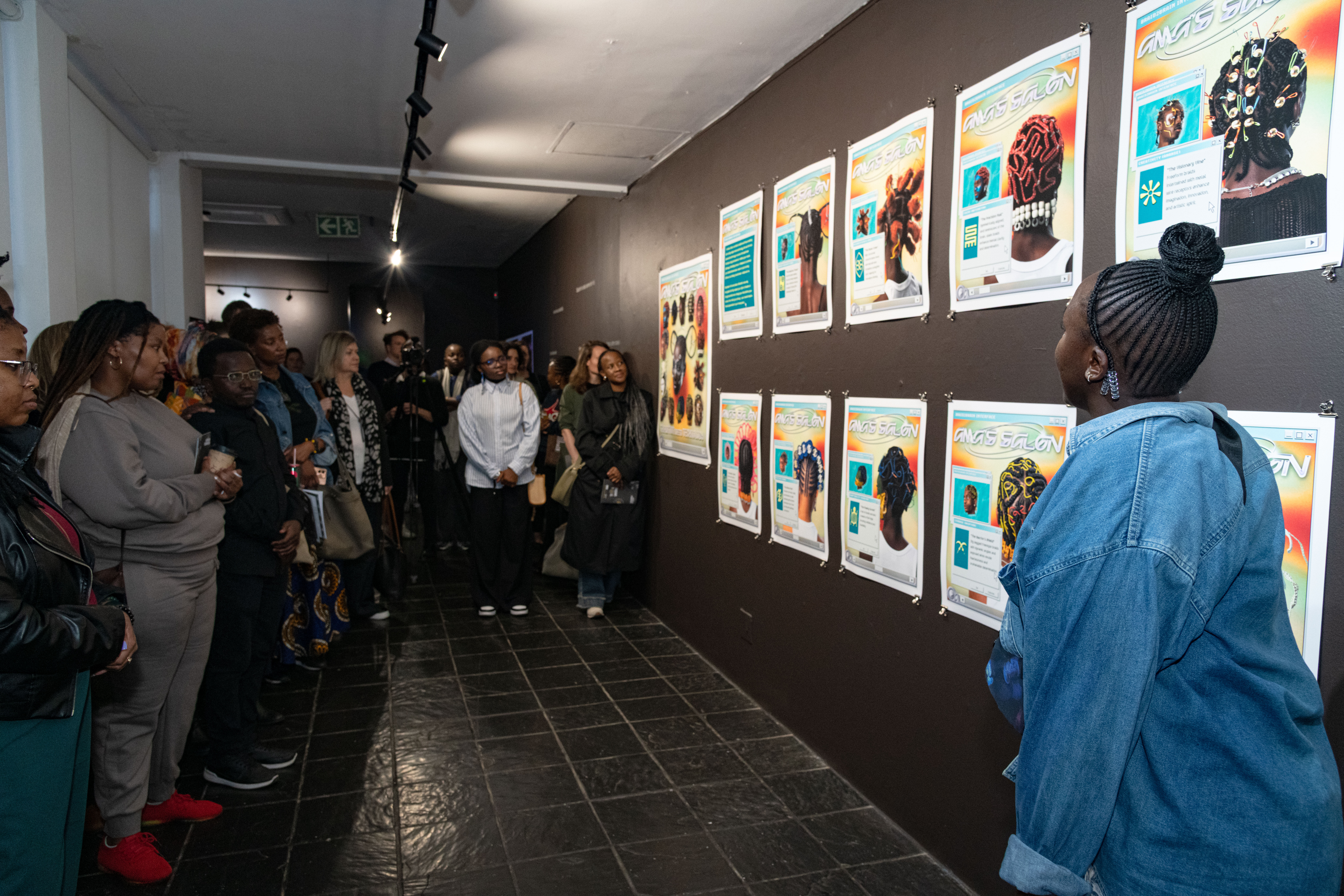
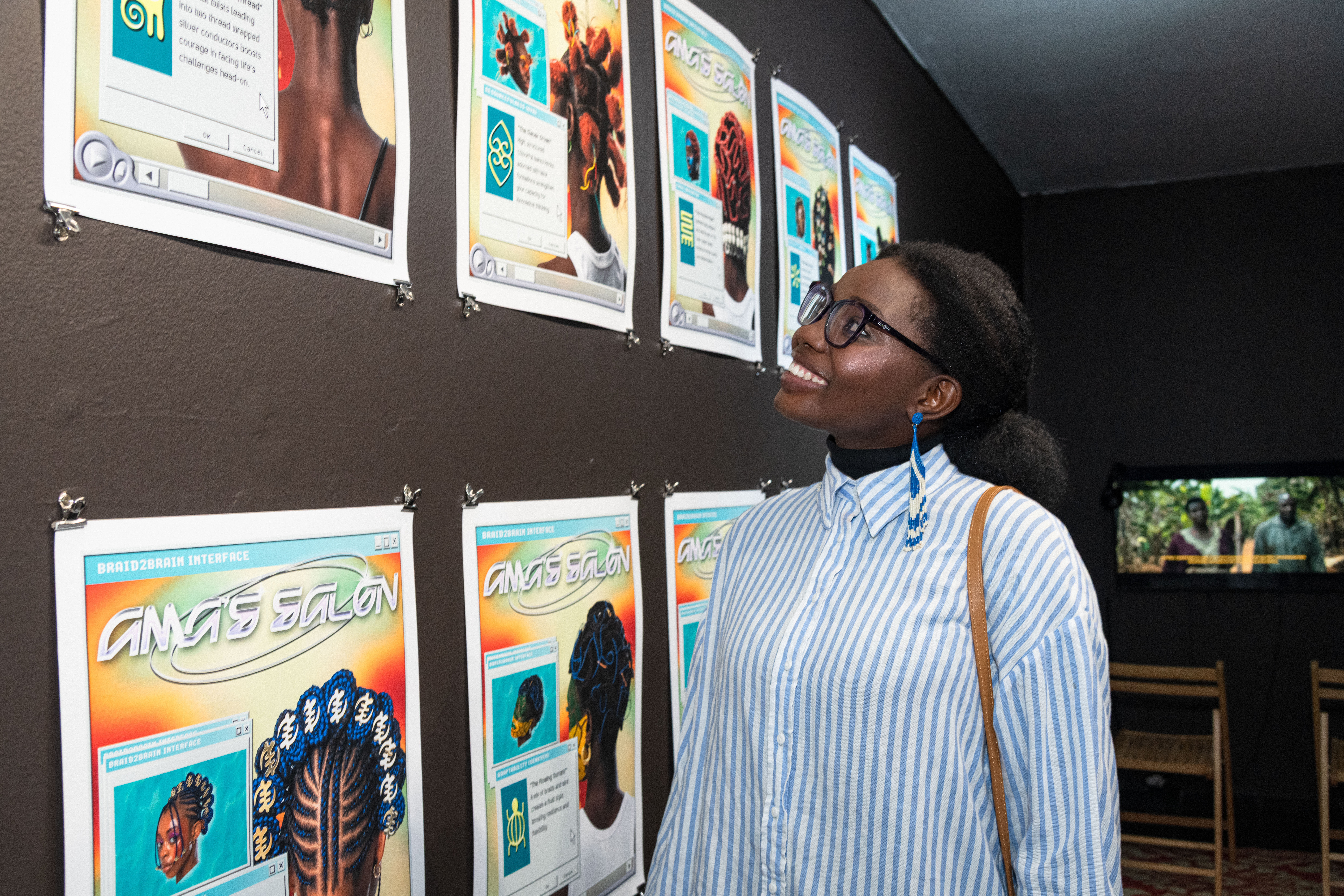
These questions sit at the heart of Ama’s Salon, a speculative project by multidisciplinary artist Asia Clarke. Set in 2056, it imagines an African salon as a site of healing and resistance, where the fictional BRAID2BRAIN Interface uses braid patterns to redirect neural pathways and transform emotional states.
Blending Afrofuturism, nostalgia, and feminist care, Ama’s Salon turns the salon into a space where technology meets tradition, and healing becomes communal. I connected with Clarke to unpack her vision and to explore how hair, memory, and courage might shape our futures.

Tell us more about yourself. Who is Asia Clarke and where did you grow up? What was it like to grow into the artist you are today?
My name is Asia Clarke, and I call myself a multidisciplinary artist because I really do a lot of things. My creative journey began around 19 or 20 when I started Wild Moon Jewelry, a handmade jewelry brand that stocked stores in Toronto and Accra. I don’t produce as much jewelry as I used to, but I still sell through a boutique in Accra called Elle Lokko.
Before jewelry, my roots were actually in hair, braiding was my first job in high school. I’d braid after school for money and practiced on my little sister’s head. That early experience shaped a lot of how I see artistry today: it’s tactile, communal, and deeply personal.
I also studied Goldsmithing in Trinidad and Tobago, where my family is from. I loved working with fine metals, but the machinery and tech required were so expensive that I eventually decided to pivot. Around the pandemic, while I was based in Ghana, I fell back into hairstyling. That’s when a lot of fashion and film productions started coming to West Africa. I was in the right place at the right time. My friend Kusi Kubi, a stylist, put me onto projects with publications like Vogue and Dazed.
In 2021, I worked on my first film with Paramount Pictures doing hair styling on set, and since then, my creative life has expanded so fast alongside motherhood. I have two children, a son and a daughter, and they’ve truly accelerated how I see time and purpose.
I also hold a Master’s in Strategic Foresight and Innovation from OCAD University, which equipped me with tools to think about the future not just as an idea, but as a model for community development. That foresight eventually shaped Ama’s Salon.
Before we talk about Ama’s Salon, please briefly tell us about Vern World and Strands and Structures.
Vern was born from my collaboration with a foresight consultancy called From Later. They specialize in long-term scenario building helping companies imagine what their operations might look like 20, 30, or even 40 years into the future.
With From Later, I created a speculative scenario set in the year 2040. In that world, surveillance is ubiquitous and relational people monitor each other in personal and societal ways. The story follows a bullied kid who commits a crime and finds ways to circumvent surveillance to get away with it. I developed it into a screenplay, then a digital scenario hosted on a website. The project received a Notable Mention at the Core77 Design Awards in 2023 my first real foray into world-building.
Strands and Structures came later, inspired by a half-collapsed building I used to pass in my Accra neighborhood. It had wires sticking out at the top that reminded me of a hairstyle and from that, the idea of creating hair sculptures in the urban anthropocene emerged. I collaborated with Ghanaian photographer and director Christian Saint, and together we developed the project over more than a year while I was pregnant with my son.
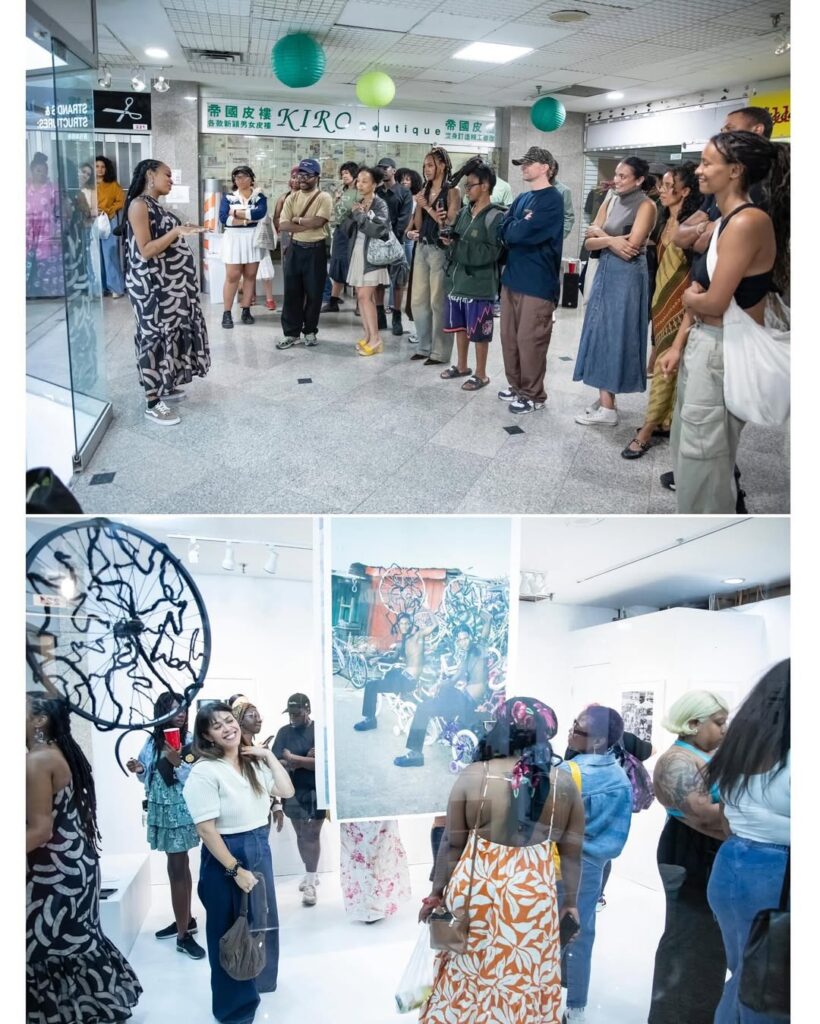
The work premiered in Accra in early 2024, then traveled to Toronto in the summer and to OSCAM Gallery in Amsterdam in 2025. It used hair sculptures to invite people to see themselves as part of their environments not separate from water, earth, or air. It’s about re-embedding ourselves in the ecosystems we often detach from.
What was the seed idea for Ama’s Salon? Was it born from personal experience, research, or an imagined future? And why the year 2056?
The original seed came from a From Later project called Memory Work, where we explored the future of women’s work in the community. As AI evolves and jobs shift, I started thinking about hairstyling a profession overwhelmingly dominated by women and its place in that future.
As a hairstylist, I’ve had countless people sit in my chair and share their lives, their pain, their joy. That intimacy made me think of hairstyling as a form of natural therapy, one that already exists in Black women’s care spaces.
From there, I began imagining a future where hairstylists could also offer mental health therapy through neural connection. I wanted to explore what happens when Black women lead conversations about technological innovation, a topic that rarely centers us.
The year 2056 came from my ongoing fascination with speculative timelines. It’s far enough ahead to stretch imagination but close enough to feel possible. It’s about exploring how technology, identity, and ancestral knowledge might merge in a not-so-distant future.
You also braid hair, when did you start, and how does it influence your work today?
I started braiding in high school, and it was my first real hustle. That practice taught me about rhythm, patience, and human connection. It’s such an intimate art , you’re touching someone’s crown, literally holding space for them. That sense of care has influenced everything I create. Whether it’s digital, sculptural, or conceptual work, it always returns to that tactile exchange of energy that happens through braiding.

How do you balance the idea of technology as healing with the fear of surveillance and control? And given that Afrofuturism often reclaims the future, what does it mean to place an African hair salon at the center of this speculative world?
That tension is exactly what interests me. On one hand, technology can heal think of Neuralink, which is exploring brain implants that might treat PTSD or depression. But it also raises huge questions about control and consent: What is your brain data worth? What happens when our innermost thoughts are no longer private?
Black women’s futures are rarely placed at the center of those conversations. Ama’s Salon reclaims that space, it imagines a world where Black women are the innovators, healers, and custodians of new technologies.
Afrofuturism, for me, isn’t just about aesthetics, it’s a reclamation of agency. Placing an African salon at the heart of this imagined world grounds futuristic speculation in something familiar, something communal. It says: our futures are braided from our pasts.
The visual language of Ama’s Salon borrows from nostalgic ’90s and early 2000s computer interfaces. Why did you choose that design style?
That era represented the early digital optimism when the internet felt new, accessible, and filled with possibility. By referencing that aesthetic, I wanted to evoke nostalgia for a time when technology felt human-scaled, not overwhelming. It’s also part of the Afrofuturist language remixing the past to imagine different futures.
You collaborated with a whole team to bring these images to life. How was that process for you?
Incredible. Once I received funding from the House of African Feminisms (project of Goethe institute of South Africa), I brought together a team of young creatives in Accra hairstylist Dzifa , who is hands down the best braider I’ve ever seen; makeup artist Judah; photographer Gus Sarkodee, stylist Nicole Dede ; and producer Brian Owusu Konadu.
We spent months prototyping hairstyles, testing wire techniques, and refining each look. Everyone brought so much passion and precision. When collaboration feels that aligned, it’s magic everything clicks, and you can feel the vision taking shape beyond you.
What was the biggest challenge in translating a deeply tactile practice like braiding into digital art?
Honestly? Breastfeeding. Laughs.
The hardest part was balancing motherhood with creative ambition. But practically speaking, I’m a big planner. We tested hairstyles four times before the shoot, met with makeup and production teams multiple times, and had every reference ready for the graphic designer. It’s about structure and intention that’s how you bring something so physical into the digital realm without losing its soul.
You debuted Ama’s Salon at the African Feminisms Gathering 2025 at Goethe-Institut Johannesburg, in partnership with House of African Feminisms and Toronto Arts Council. How did that come about? Did you apply or pitch?
I applied. The House of African Feminisms put out a call for proposals asking artists to explore what African feminisms could look like in the future. My project felt perfectly aligned; it preserves ancestral knowledge while using hair as both cultural and technological language.
I went through an interview process, got accepted, and eventually received funding in March. We shot the project that same month, and it debuted at the African Feminisms Gathering at Goethe-Institut of South Africa in Johannesburg. I couldn’t attend in person, but seeing photos of people engaging with the work was deeply fulfilling.
I also received support from the Toronto Arts Council, which has funded several of my speculative projects. I’ve learned that successful grant writing is about showing funders that the work will happen regardless they’re joining a moving train, not fueling the first spark.
Do you see Ama’s Salon as an ongoing project that could evolve maybe even into a real-world prototype of Braid2Brain therapy? And how do you want your work to influence the next generation of artists exploring identity, technology, and healing?
Absolutely. I already have expansion plans from a short film to a speculative citizen lab that brings hairstylists, scientists, and community members together to explore functional hairstyles as interfaces.
I’d love to partner with festivals like Afropunk or AfroFuture to bring Ama’s Salon into physical spaces tactile, offline, and collaborative. We’ve spent too long interacting through screens. I want people to gather, build, and imagine futures together.
If there’s one thing I hope younger artists take from this, it’s that the future isn’t something distant, it’s a story we get to braid ourselves.
CREDITS
creative director/hair: Asia Clarke @wild_moon
producer: Brian Benjamin @brian_benjamin.__
asst producer: Laze @lazy.mondays
asst art direction: Dzifa @dzifaak.braid
director: Catia Correia @catiyahhh
ad: Laze @lazy.mondays
dop: Jazira @beyondjazira
ac: Abdul Wasiu @_geayer
edit & vfx: Solomon Agyei @agyei__solomon
photographer: Gus Sarkodee @g.sarkodee
styling: Nicole Dede & Kojo Lartey @nicole_coffie @koojo_koojo
styling asst: @shineorgocrazyy
mua: Judahsmakeover @judahsmakeover_
@jvdah_hvmself @Mae.studio.__ @Octobersbeautyofficial @_ahunya
production asst: Asiedua & Naa @__asiedua @naa.shormeyy
catering: cheddar&spice @cheddarandspice
graphic design: Dasebre Osei @dasebre_osei
casting: @2impressmgmt @smallcrowdd
Production company: Smallcrowdd @smallcrowdd
Bts: Naa @naa.shormeyy
Models:
Bentiwaah @bentiwaah_addison
Suzette @iamalivingdoxology
Josephine @josekunadu
Kezia @kezia_agyemanboafo
Kuba @kuba_acquah
Ewurabena @ewurabena.berko
Joel @c.j.rajii
Adom @adom.gee
Gabriel gabe_l5
Nathaniel @nathanielanku
Ziwi @i.ziwi

