

Jakinda Boya
Interview by Anastatia Nkhuna
Raised between Johannesburg and East London, Jakinda’s early life was shaped by both curiosity and contradiction. Growing up in a conservative and sheltered household, he spent much of his childhood immersed in an interior world, drawn to art, music and ideas beyond the boundaries of his immediate environment. A formative move from Johannesburg to the Eastern Cape exposed him to different ways of thinking and belonging, experiences that would later inform the quiet observational nature of his practice.
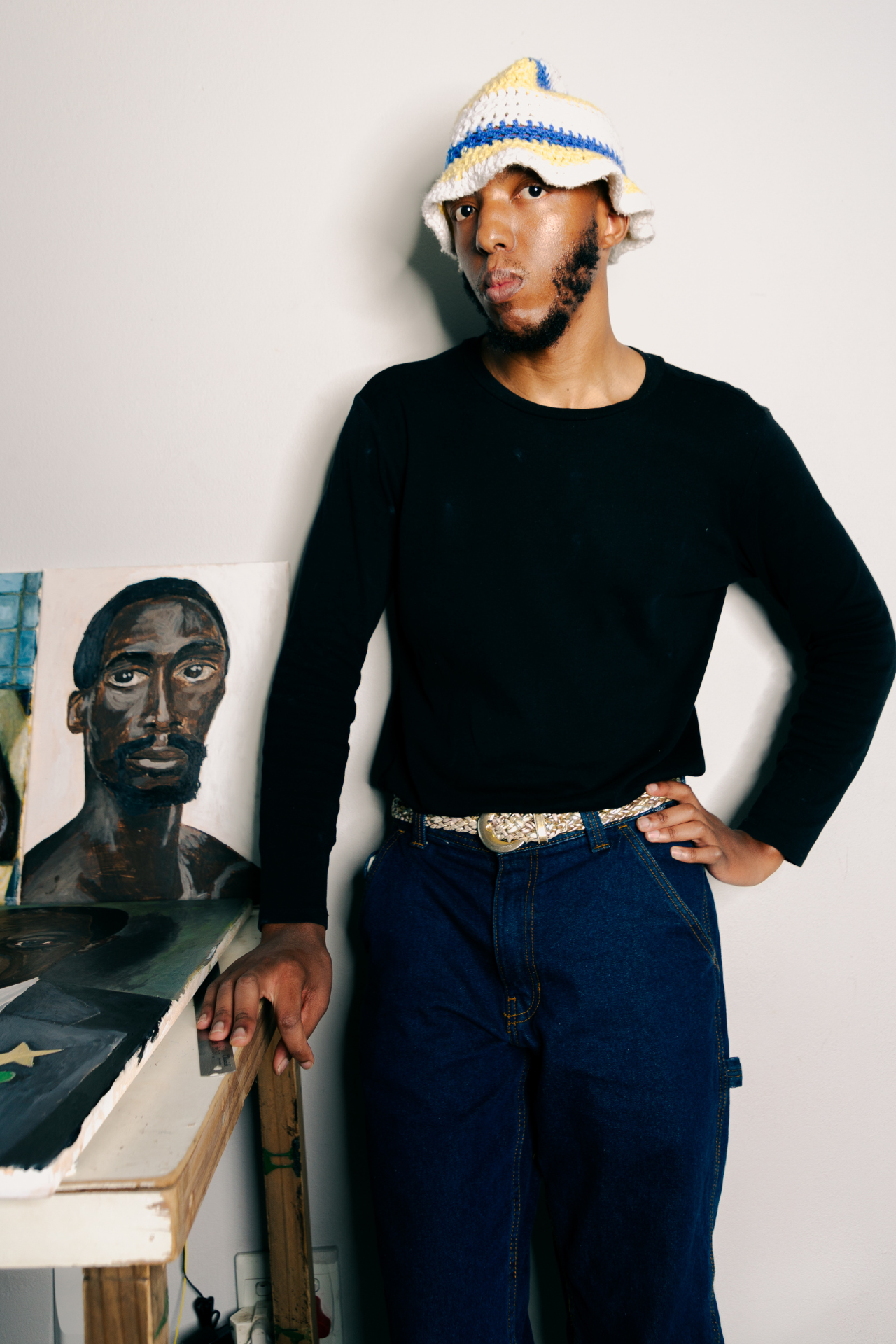
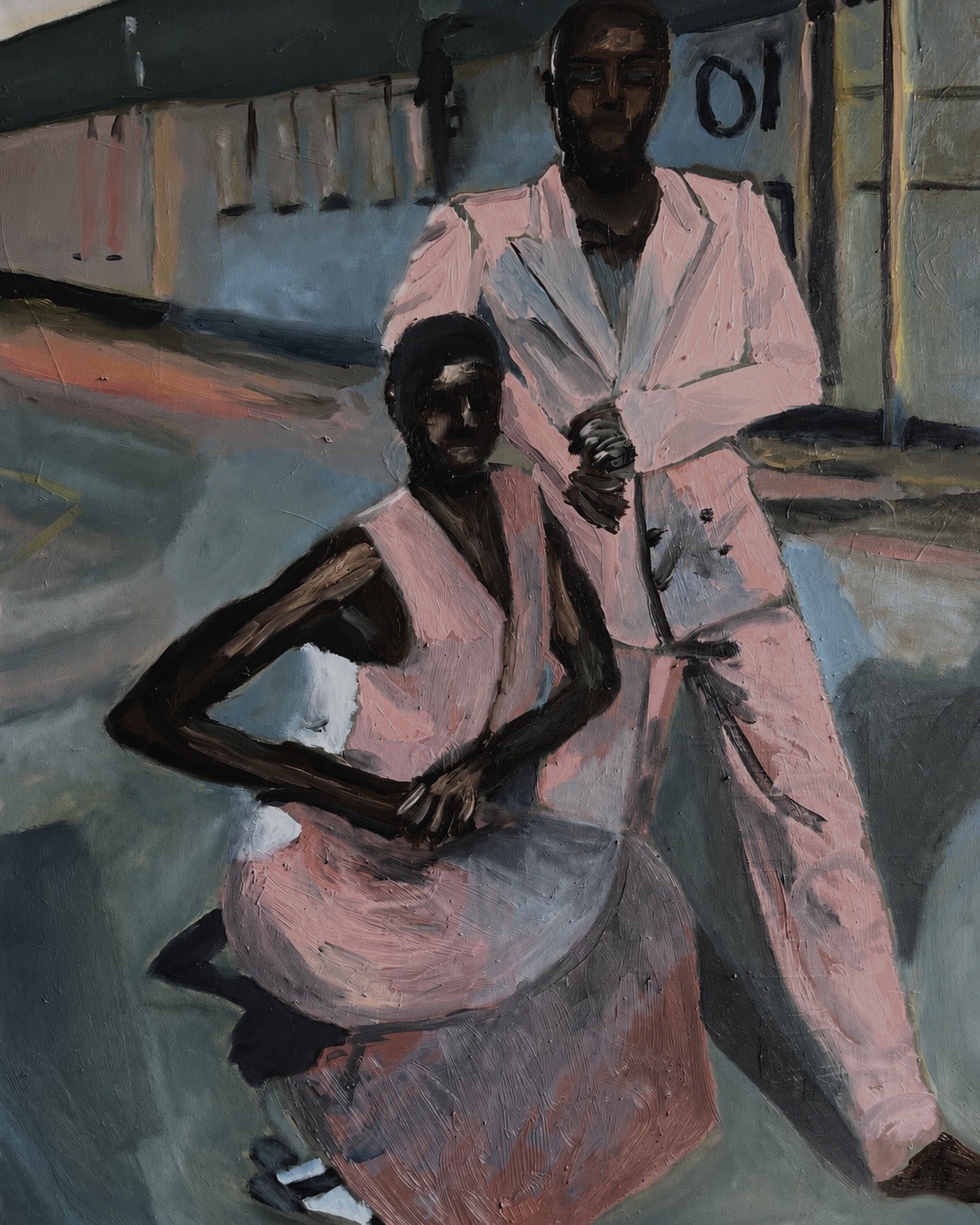
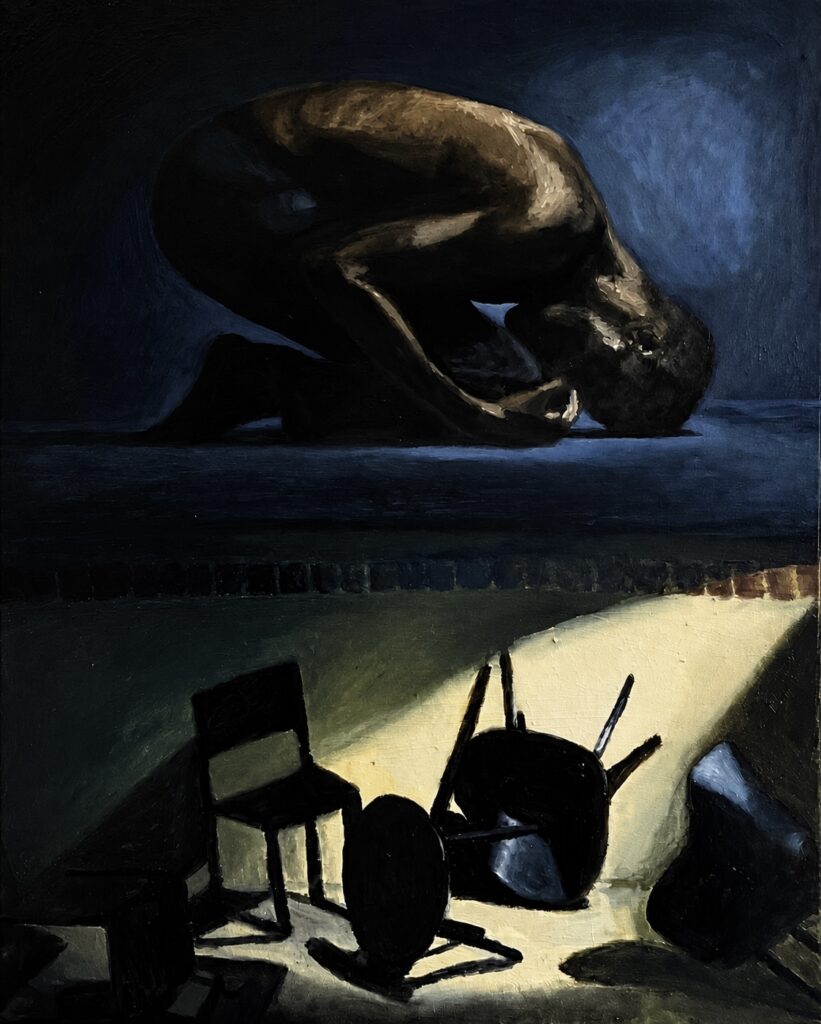
Today, Jakinda works primarily through painting, a medium he describes as both solitary and deeply personal. While many first encountered him through music, painting became the space where his ideas could exist unfiltered, a direct conversation between artist and canvas. Through contemporary figurative painting, he explores vulnerability, masculinity, psychological tension and the fragility of the human condition.
For Jakinda, painting is not only a means of expression but a way of participating in a broader historical and political lineage, using a centuries-old medium to confront contemporary realities and give form to the questions that continue to shape life in Johannesburg and beyond.

Tell me more about your upbringing. (Describe yourself as a child)
I was born in Joburg. I actually grew up in Kensington, but around the age of 8, when I was turning nine, we moved to the Eastern Cape and I lived there for about five years. It was a big change for me because I had grown up in a big city, all my friends were in Joburg, and suddenly I was uprooted and moved to East London, which is a much smaller city.
I didn’t enjoy it at all when I was there. I really missed being in Joburg. Eventually, around the end of Grade 8, before going into Grade 9, we moved back. When I tell people where I grew up, I mostly say Joburg, but that period in the Eastern Cape had a big impact on me. I think it gave me a different perspective. The thinking in East London was very different to Joburg. In Joburg you’re exposed to so much more, whereas people weren’t exposed to as much there.
I used to get made fun of because of the way I spoke, the things I was interested in, and the way I dressed. That had a big impact on the shy personality I have now.
As a child, I was very playful. I liked hanging out with my friends, but I was also very much an indoors kid because my parents were strict and didn’t really let me go out. A lot of my upbringing was sheltered. I was always in my own interior world and wasn’t really allowed to go outside unless it was for school or directly to a friend’s house.
I was always curious and creative. I was interested in art, music, and things that existed outside of the world I was exposed to by my parents. My parents were quite conservative. They didn’t really go out, drink, or smoke, so my curiosity about the outside world was something they didn’t fully understand. I think they were trying to protect me, but I was always curious about what existed beyond that.
Right now, who is Jakinda and why painting? What did that shift demand from you, both mentally and emotionally?
It’s not really a linear path. When I was young, I was very interested in art and, for some reason, I thought I would become an artist one day. That wasn’t necessarily nurtured by my parents, but curiosity was always there.
I was always drawing, and then at some point I became curious about music. For a lot of people, their first introduction to me was actually through music. I think everything came from curiosity and trying the things I felt drawn to.
What I really love about painting is that it’s just me. It’s a raw expression. The idea is expressed directly by me onto the canvas. With music, I was mostly working collaboratively, and I still enjoy that, but there was always a part of me that wanted people to see ideas coming directly from me, without anyone else being involved.
Painting is very solitary and private. It’s just me. No one else is telling me what to do. I also love the history of it. By being a painter, I’m participating in a very long history. There’s also a political aspect to it. As a Black painter, I’m aware of how dominated the history of art has been by white painters and white art.
I’ve always had a desire to be heard, and painting felt like a loudspeaker for me. If I was going to be an artist, this felt like a medium where people pay attention, and where my voice could be heard.

Your work under lil.loewe feels deeply attuned to Contemporary Figurative Painting. What are you noticing about people that insists on being translated into paint?
I’m very fascinated by people. Because I’m such a quiet person, I observe a lot. I watch how people interact with one another.
One thing I notice is that people often aren’t honest about some of the harsher realities of life because they’re painful to speak about. Sometimes people are in denial about them. I often struggle to build deep connections because there’s a barrier to vulnerability. People don’t really want to be honest about what they think or feel.
I grew up in a political household and was raised to be aware of how the world works and the systems at play. I often wanted to talk about things like capitalism, inequality, and systemic issues, but there wasn’t always a willingness from people to engage with those conversations.
Painting allows me to delve into those issues in a way that’s accessible. People are drawn into an image, but the longer they look, the more they realise it’s about much more than what appears on the surface.
Painting creates an ambiguous space. It allows me to engage with ideas and issues in a way that’s subversive. Through paint, I can pull people into conversations they’ve been avoiding.

Painting is often solitary and slow. In contrast to the immediacy of music and digital culture. What has that discipline taught you about yourself and your creative process?
Painting has taught me that I’m not very patient. I’m impatient, and I can be quite lazy too.
Painting exposed that about me because if you’re impatient, especially with oil painting, you can ruin the whole painting. The paint takes time to dry, and if you rush certain things, you can destroy the work.
With music, things felt different. Making music is fun. I really enjoyed making music with Ayema and still do. You can fall into the feeling of it. You don’t necessarily need a deep artistic statement for every piece of music, even though the music we were making was experimental and deeper than simply creating something to dance to.
With music, I didn’t have to speak as much. The music could do the talking, which suited someone like me who is naturally shy.
The biggest thing painting has shown me is that I’m more resilient than I thought. I’ve always imagined being an artist, even when I knew the struggles that came with it. As a child, I would hear that artists are probably going to be broke, and I would say I didn’t mind.
Now that I’m actually living it and facing real struggles, I’ve realised that I keep doing it anyway. No matter how difficult it gets, I continue. Painting has shown me that I’m much more resilient than I thought I was.

Your work explores the tension between strength and vulnerability within Black masculinity. What does psychological endurance look like to you in today's Johannesburg?
For a long time I’ve been interested in masculinity, particularly men and the expectation that they constantly perform strength.
Growing up in a Xhosa household, I was always told that as a man I would eventually have to become a provider and leader. There is a whole rite of passage attached to becoming a man. I became interested in the pressure that comes with those expectations.
There’s this idea that men must always be dependable, stable, and have the answers. At the same time, they’re carrying a psychological weight. Vulnerability isn’t always allowed. You’re expected to keep functioning regardless of how overwhelmed you may feel.
My work explores that tension between the figure you’re trying to perform as and the pressure that performance creates. Many of my subjects exist in a limbo where they’re trying to maintain strength while simultaneously buckling under the weight of expectation.
More recently, I’ve begun looking at masculinity beyond men themselves. I’m interested in masculinity as a performance of strength. A single mother, for example, is often described as both mother and father because she performs roles traditionally associated with both. We also see how women who display strength are often described in masculine terms.
I’m interested in masculinity as a broader condition, this performance of strength and what it costs psychologically.

In a culture that rewards speed and visibility, choosing slowness and solitude almost feels like resistance. What are you rejecting by committing to painting right now?
I love the permanence of painting.
When you make a painting, it’s not like something on Instagram that someone scrolls past and never looks at again. A painting asks people to spend time with it. It continues to exist in the world and can be returned to and reflected upon.
We live in a world where so much is digitised. There is AI, instant gratification, and everything feels increasingly fast-paced. I love the fact that painting is a counterpoint to that. It asks people to slow down, pay attention, and think more deeply.
There’s something powerful about the physical and tangible nature of a painting, much like a book. The medium itself carries centuries of history. I love that you can use something rooted in tradition to speak about contemporary issues.
That connection can’t be replaced by a screen. Painting offers something different. By committing to it, I think I’m rejecting the hyper-commercial and consumerist culture we live in now.

Your work sits between anonymity and identity, softness and confrontation. Do you see your practice as a form of self-preservation, or self-exposure?
I think it’s both.
There are so many things that I think about that I don’t always know how to articulate through conversation. I don’t feel like I have enough conversations to get everything out, so I often feel like I’m carrying a lot inside me that needs expression.
The work allows all of that to come out in a raw, vulnerable, and honest way.
At the same time, there’s also a very human desire to leave something behind. I want evidence that I was here and that this is what I had to say. In terms of self-preservation, painting brings me closer to a sense of purpose. Every time I paint, I feel like I’m following a gift or calling that I have.
The work becomes an archive, not necessarily of who I was, but of my contribution to conversations about the human condition. Through the work, my memory can live on through the contribution I make to broader conversations about who we are as people.
If your paintings are documenting the psychological frequencies of Johannesburg, what truths are you revealing that people might not be ready to confront yet?
A lot of my work is underpinned by philosophical realism, particularly the ideas of Thomas Hobbes.
Hobbes argues that what prevents us from destroying one another is a social contract. We agree not to harm one another because it benefits us both to survive. But that contract is fragile. One of his most famous ideas is that life is “nasty, brutish, and short.” What he’s really pointing to is the precariousness of human existence. There is always tension beneath the surface.
As Black people, that social contract often feels unstable because the systems and institutions that are supposed to uphold it frequently fail us. Our condition remains uncertain. The truth I’m exploring is that fragility. There is a psychological tension that exists in everyday life. A feeling that there is always a looming risk, an uncertainty, a vulnerability.
That’s why so much of my work contains darkness, ambiguity, and unresolved tension. No matter how much strength we perform, we’re still vulnerable. We’re still at risk. I keep returning to that idea: that human life is precarious, that we exist in a kind of limbo, and that there is always a looming uncertainty beneath the surface of our daily lives.
about who we are as people.