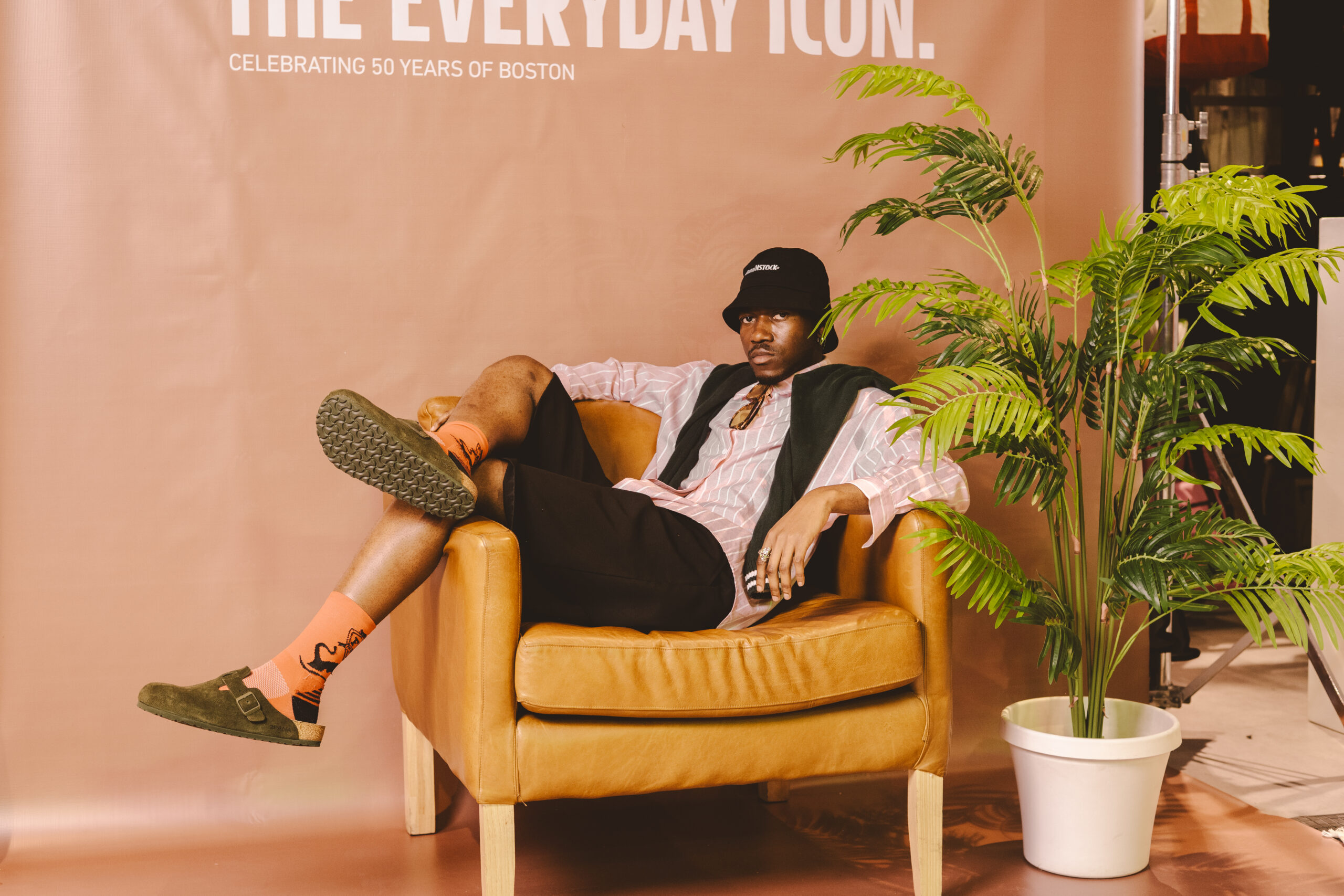
“When we’re in studio, no one has one set role. The fluidity of our roles is what makes us stronger ”
— Johnny Basz
Written by Hlengiwe Mkwayi
I first stumbled across Wav Gardn through a mindless Tiktok scroll when Umzi Watsha cut through the noise and stopped me in my tracks. But my first real encounter came later, and in the flesh, at their live performance during a Narow-Bi event, through a set that turned casual curiosity into true admiration.
The Pretoria-based Neo Futuristic Soul band filled the space with a kind of warmth that felt both intimate and expansive. With music layered with experimental alternative textures, the spiritual pull of soul, and the grounding familiarity of African folk, Wav Gardn’s sound wraps around the audience like a sonic hug.
Fronted by lead vocalist Siiisa and guided by music director, producer, and curator Johnny Basz, the group also features Finny, “the producer guy with the great ear,” Lungsta, the people’s keyboardist, and drummer extraordinaire Tumiso, affectionately known as De’tumi. Together, they create what they call a synth wave of love; music that restores, reflects, and reminds you of home, whether that’s a place, a feeling, or the first sip of a hot cup of coffee.
I had to privilege to sit with three of the five band members to chat about music as a sonic hug, and how their creative process is steeped in nostalgia, rooted in culture, and unafraid to weave together the sounds of home.
What inspired the name Wav Gardn?
Johnny: I’m a producer and I came up with the name. A WAV is the highest form of audio quality, right? You can find either a WAV or FLAC file, but we usually work with WAVs. So what that name means is that we’re basically a garden of high-quality music.
You guys pull up as a whole squad. Please tell me about your genesis.
Johnny: The band itself isn’t that old, we’re only about a year in, but we’ve all been making music for a long time. Between the three of us, there’s probably around 30 to 40 years of combined experience, which is kind of wild when you think about it.
I first met Siiisa in late 2023. We didn’t start working together right away, but I pitched the idea back then because I really wanted us to collaborate. It took about a year before we actually started. Around that time, I also met him, uFinny; he came to some session I was doing with a different artist. I remember thinking, you should come back more often, because he was really proactive in making the music. There was no unnecessary talking, just focused on creating. That’s rare, and I appreciated it.
Eventually, I invited Siiisa, and last year, the three of us ended up in the studio together. That’s when we made Umzi Watsha, our debut single, which dropped in August. That moment really marked the start of the band. It came together organically with one person here, another person there, until we found the right combination. And now, it’s not just about the three of us making music.

And how did you each come into music respectively?
Johnny: I think I knew as early as Grade 4 or 5 that this was what I wanted to do. I still remember the first time I opened a DAW, a music-making program, at my friend’s house. His older brother was a DJ, and because we were young, we weren’t allowed in his room while he and his friends were making music. So we’d hang out elsewhere, waiting.
The moment they left, we’d sneak into his room, open the computer, and start playing around. Obviously, the stuff we made was terrible but just the idea that I could make music was mind-blowing. Up until then, it hadn’t even occurred to me that it was possible. That was my first real introduction to the idea of creating music, and it stuck with me. By the time I was in matric, I’d told my parents straight up: I don’t see myself doing anything else. I’ve never dreamt about another career or imagined a different path. It’s been this one thing since I was a kid.
Finny: It’s almost a similar story to Johnny’s, but for me, it started with my uncle. He used to record himself on tape; he’d put in a cassette and somehow capture his voice or music. I don’t even know exactly how he did it, but as a kid, I found it fascinating.
Whenever he wasn’t around, I’d mess around with his tapes (wasting them, really) so when he came back, whatever was on them had completely changed. That curiosity stuck with me. Later, I got introduced to FL Studio through my friends back home, and that was it. From there, I knew this was something I wanted to do.
Siiisa: For me, music was always present, always playing at home. I was that child who loved to talk, and I think that talking slowly turned into singing. My real introduction to music came when I was about 10 or 11, when I started playing instruments at school. From then until I was about 18 or 19, I was classically trained.
I played in orchestras in the Eastern Cape, performed at the Baxter Theatre in Cape Town, and toured with a band. I had a mentor, Nikki Coleman, a professional trumpeter, who changed my life. At one point, I was preparing for an international Trinity School of London exam. My parents refused to pay for it, they just didn’t understand it, so Nikki stepped in and paid. I passed with merit. That moment validated something for me: maybe this was the leap I could take.
I wanted to study music, but my parents still said no. So I took a gap year, moved to Pretoria, and decided to try another angle: singing. I’d always known, even at 11 or 12, that I wanted to either be a lawyer or a singer. But the truth is, the singing has always been there. Nothing else makes sense to me now. I can’t see myself as a corporate baddie, it’s just not the life I want. Music is life. And I’m so honored to have met these incredible people I now make music with. What we’re creating together is worth living for, and I have no regrets.
You describe your music as “audio hugs”. How do you translate warmth and physical embrace into sound, both in songwriting and live performance?
Siiisa: It is important to us to create music that translates into love and warmth. When we make music, we always start by huddling up in a circle and talking about our day and what’s going on in our lives. It’s a way to connect with each other and sets the tone for the session. By the end of the day, the music we create often carries that feeling; what we make ends up feeling like a genuine hug. I usually leave as a different person: more positive, more hopeful, and looking forward to life.
The first time I heard you live was at Narow-Bi and I was immediately drawn. That is also where we got to hear the first Dabawo for the first time. What inspired the song?
Siiisa: We were in the studio when our drummer, uTumiso, came up with the first chord progression. He’d actually had it for a while, and when he played it for me, it immediately took me back home.
I grew up in a family that deeply embraced our culture. We had many celebrations, and that chord progression brought back images of Umgidi; the dancing, chanting, my parents in a circle, and iGubu that is played when everyone gathers.
It also made me think of our aunts because they’ve played such a huge role in my life. I’ve been blessed to have amazing relationships with mine, and I wanted the song to pay homage to them. When I started writing, I shared the idea with Andy Maveric, who’s also part of our crew. He loved it instantly and could relate with him being Xhosa, so the themes resonated with him. When we brought the idea to the rest of the band, they connected to it too. Many of them have their own memories of their grandmothers as the backbone of the family.
So, collectively, we decided this song would be a tribute to our mothers, our aunts, to the culture that shaped us, and to the sense of home that lives in all of us.
Finny: As a collective, we were all keen to embrace the cultural aspect of it wholeheartedly.
Johnny: The instrumentation is also then us drawing from our shared background; Finny & I are both Pedi. There’s a style of music in Polokwane, part of my culture, called Dinaka. It’s not exactly jazz, but it carries a similar richness, with a deeply spiritual quality to its sound. For this particular song, we wanted to infuse a lot of that influence.
Siiisa was bringing in strong Xhosa elements, and we didn’t want the track to reflect just one tribe. In fact, across our album, the music is never centered on a single culture. It’s multilingual and feels like a tapestry of sounds from all over South Africa.
And I guess that’s also how Espacio Dios enters the frame?
Siiisa: He’s such an amazing writer. His music alone is enough for people to understand why we’d want him on a record. He has a very unique tone, a sound that stands out. And beyond that, he’s deeply in touch with his cultural roots, which was a big part of what made him such an attractive collaborator for this song.
Johnny: So what happened with that song is that they didn’t know I was sending it to Espacio for a feature. I made that decision without telling them. Honestly, if it hadn’t worked out, I probably would’ve caught some serious heat. At the time, we had already decided it was going to be our single. It was out for mixing and mastering, and we were just waiting for it to come back. I sent it to Espacio with a simple, “Yo, this is our next single, just have a listen.” I didn’t ask him to record anything; I was just giving him an exclusive preview.
He calls me almost immediately and says, “Bro, I’m in the studio right now. I’m going to send you something. Please forward it to an engineer too.” I thought, Eish… okay, let’s just see how it sounds. He recorded it, sent it back, and I dropped it in our group chat with, “If you guys don’t agree, I understand. But if you do… let’s take it where it’s supposed to go.”

What inspired the song Ndize (Ndawo Yam’)?
Siiisa: The lyricism was inspired by that nostalgic feeling of missing home and longing to be there. Some of us live far from where we grew up, and personally, I don’t get to visit as often as I’d like. From my perspective, writing this song felt like crafting a love letter to home; promising to return, yearning to return.
There’s a kind of rejuvenation that comes with being home, a sense of being centered. That feeling really shaped the mood of the song. It was born from that deep, almost aching desire to be back in that space, and the hope that writing about it could make me feel closer to it. I remember when we were making the track, Johnny mentioned it reminded him of being home on Sundays.
Johnny: Yes! It reminded me of Sunday lunch. Back when I was young we’d go to church… I think this was the case in most Black families: my mother or grandmother would wake up early in the morning to start cooking, then we’d head to church. When we came back, the food would be ready, and we’d all sit down and eat together. So that family setting, that sense of togetherness, that’s what it brought back for me.
Siiisa: When I was younger, my parents, my sisters, and I loved to travel. We’d drive everywhere, well they drove, and we just enjoyed the ride. I remember how there would always be a sunrise or sunset marking the journey. Sometimes we’d be approaching home, other times we’d be in another city, but there was always that view: the soft light, the vegetation, a bit of fog, mountains in the distance.
The song for me also took me back to that feeling of traveling with my parents, of missing them now. It’s the same kind of nostalgia I get from a hot cup of coffee on a Sunday, paired with Sunday lunch. Those small, comforting details are the emotions that Ndize (Ndawo Yam’) tapped into for me.
What are your hearts’ desires for Wav Gardn?
Siiisa: Definitely releasing more albums and touring. We believe the world needs love, and we think the world would want to hear Wav Gardn and what we have to offer. We want to spread really good energy out there. So, yes, touring is a big one.
Beyond that, we want to have an impact on people’s lives. That’s the most important thing we’re striving for.
Johnny: For me, the goal right now is to put out a great album, an amazing debut that we can all be proud of. I’ve been stressing this to everyone in Wav Garden: I want it to be so good that we wouldn’t need to release another album for the next four years. That’s the standard we’re aiming for.
If we can put out that kind of album, it will open the door to so many things and not just for us as a band, but for the people in our lives as well.
I’d like for each of you to give me one word of what you would like people to take away from your music.
Finny: Love.
Johnny: [laughs] I knew he would say that! I’d say Introspection.
Siiisa: Spirit.